Pieces of Me

The other night, I watched a new film on Netflix called “Pieces of a Woman.” It burrowed into my soul like the vaccination needle into your arm. Yet surprisingly, the subtle and deftly poignant images packed the most potent punch.

This provocative film takes us on the horrifying journey of a home birth gone tragically wrong, but that’s just the first half of the story. (Spoiler alert.) Though the cataclysmic event is harrowing and devasting, some of the most profound and affecting moments come after it.  Perhaps, I experienced the narrative in this way, because this heartbroken mother’s journey is similar to my own. Though the particular circumstances are different, the gravity of losing a child at any age carries its own unique, untenable weight.

“Elaine, why would you subject yourself to such a sad, triggering film?” one might ask, and one would be justified in posing that question.

But the answer might be just as confounding. As I walk this unbearable path, I find that connecting to others around our shared,  unrelenting pain—often through art, helps me feel less alone and even witnessed in a misery-loves-company sort of way. Being seen is a momentary salve on the gaping, unhealable wound.  And frankly, it takes the focus off me for a brief instant and gives me another way to contextualize what still feels impossible to believe.

Not every moment in “Pieces of a Woman” works, but this kind of story signifies a gradual shift in the way we are acknowledging grief in our culture. In the second half of the film, we come face-to-face with a woman’s unvarnished grief journey and emotional fallout—exposed, raw and unapologetic.  Martha’s grief takes center stage, often colliding with her husband’s incongruent mode of coping—ignited by rage and alcohol. Her pain is there for all those around her to see—in all its awkwardness and messiness.  Most people I encounter want someone who has suffered a tragic loss to get over it quickly and be “OK,” because they don’t want to face their own looming mortality. But Martha bears all.

Ellen Burstyn is brilliant and riveting as Martha’s mother—mounting a hostile resistance against her daughter’s unfathomable pain that also prevents her from providing the compassion and care her daughter aches for. In Burstyn’s mordant revulsion to her daughter’s festering sorrow, we sense her character’s own inability to process difficult feelings. This is at the same time fiercely intimate and unflinchingly universal.

 “You’ve got to fight and seek revenge,” she barks. “That’s the only way you can move on.”

The grim reality is you never move on. You don’t “get over” the love of your child. You just find a way to carry the pain.

In fact, Martha vehemently protests the concept of revenge. In one of the most searing moments in the film, Martha finds a beautiful photo her husband snapped on that bittersweet day, just after she delivered her baby. As she views image, we see Martha’s hardened heart soften like molten lava. She begins to replace some of the hard darkness with light, some of the fierce anguish with love. I felt that so deeply. She actually begins to forgive—her midwife, her husband, her mother, and perhaps, even herself.

The other gorgeous detail that brings me to tears is Martha’s meticulous collection of apple seeds, nurturing them carefully in cotton pads or tiny blankets in the refrigerator. She mentions at one point that her newborn smelled like apples, and we often see her eating apples—unconsciously drawn to them in the grocery store, as well.  But when she opens the refrigerator one day to check on them, she discovers they’ve begun to sprout and bud, and she is awestruck by the persistence of nature and the miracle of life before her eyes. This becomes its own solace, its own comfort. This stunning nuance seeped into every cell as I empathized with every tear she shed; every wail she unleashed. The sensitivity of this storytelling is breathtaking—and the performances, masterful, as devastating as it is glorious. This shattered mother is able to find a glimpse of grace and a moment of infinite connection—an uncharted path back inside her own shattered heart.

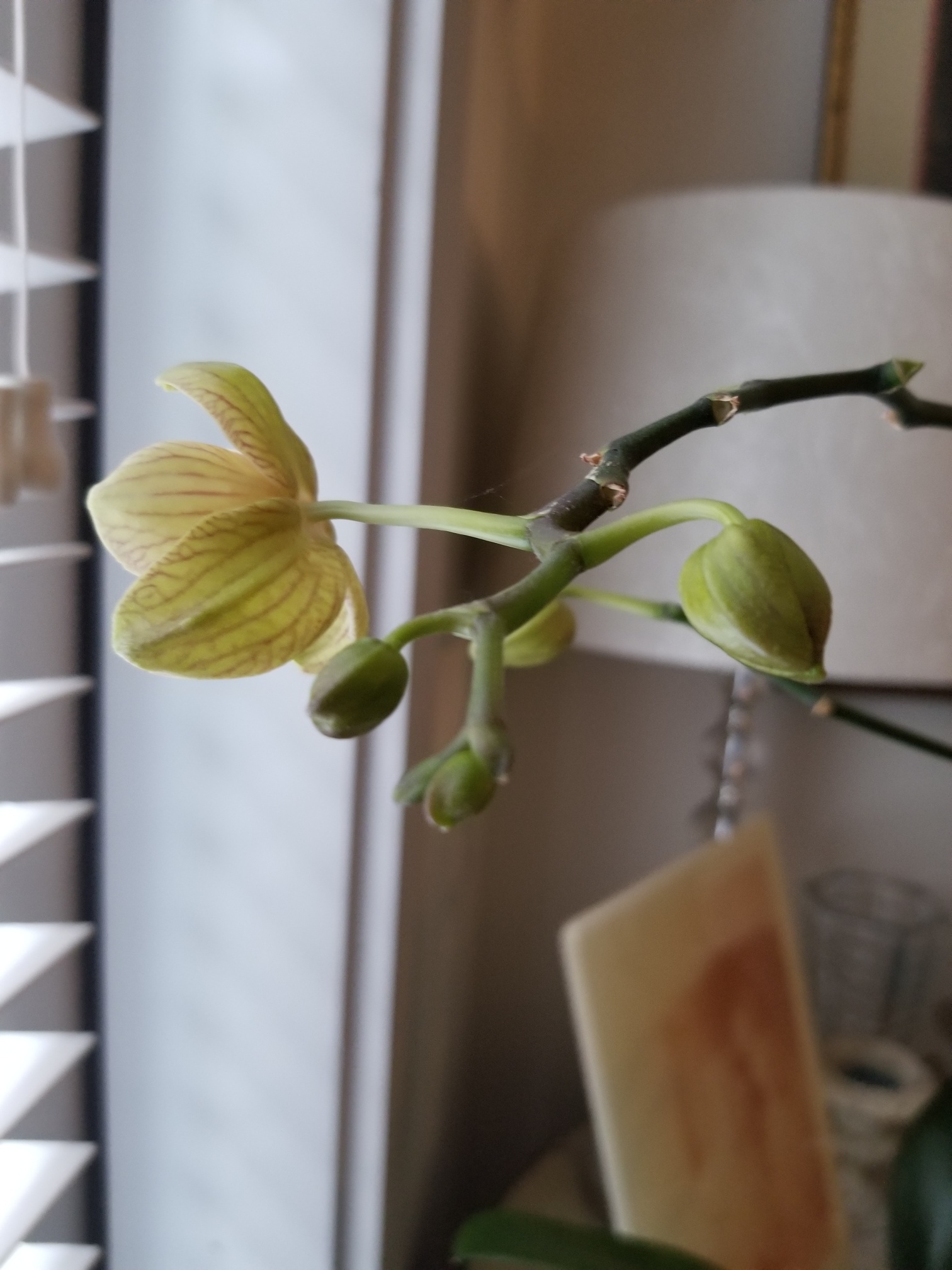
Today, I noticed a similar miracle in my own living room. The delicate orchid plant a friend gave me for my birthday about six months ago had lost all its blooms. Since the leaves remained green,  I continued to water it as my late Aunt Virginia, the orchid whisperer, had instructed. She used a turkey baster to gently inject two squeezes per week. Carefully infusing every Saturday, I have been watching the tiny green pouches with anticipation, and to my surprise, one opened this morning—a fragile, tiny orchid saying, “Hello world.” 

Like Martha when she lifted the carefully arranged cotton pouches from her refrigerator, tears welled. There is something magical and comforting about witnessing life  . . . its brazen persistence, the continuity of creation, the divine order of things. I must allow this to sink in, to feel it down to my marrow. Another day . . . another glimpse of grace.

Poetry in Progress

This has been a poignant and moving week—punctuated by the power of words and the vulnerability of relief. Tears have welled spontaneously and frequently. And synchronicity has worked in mysterious ways. Last weekend, I participated in a profound and revelatory writing workshop with poetry priestess Meghan Adler. Astonishing, informative, and inspiring.

I am exceedingly grateful for every moment spent in the company of this sacred circle. Here are a couple of poems:

NOTICING ELLIOT

I notice the always ache
I notice the awful gravity of gone
I notice my breath beside a stream of sea-salt tears
I notice the volume of your absence
I notice the hallow of my emptiness
and accept it as peace.
I notice the fading jet trail against the bright azure sky—
dangling like a cotton thread from heaven.
Then, I notice your brother’s laughter in the other room.
I notice what I notice—and I wonder. Are you there?

MO MEMORIES

They say Mo-Ranch is a thin place, where the edges blur between now and then.
I say Mo is a dream, a collection, really—had, made, and missed.
Mo is a gene attached to my DNA—crafted and careening without fear down a creaky wooden slide into the cool green ripples.
Mo is a memory, bittersweet and fragile, like a scoop of Blue Bell in July. Mo is a feeling. Forever and never again—still, inhabiting my heart.
Mo was saxophones, songs, and s’mores. Can this be all that family is?
But now, Mo is a time to remember and to grieve,
held in the river’s lap by day and wrapped in glitter’s blanket by night.
We say it’s not just a place at all.
It flows through all who know Mo—by grace.

The Thing with Feathers

Grief.

It comes in many forms, and its spikey talons dig into your flesh, heart, and soul with varying degrees of force, pressure, and duration.

But there is another layer now, a cacophony of angry, bellicose voices that surround, infiltrate, and pierce us relentlessly—pinging and careening like atomic particles in a supercollider of accelerating chaos. David Brooks said in The New York Times this week, “There are dark specters running through our nation—beasts with shaggy manes and feral teeth.”  The reality is that these events in America continue to weigh on us like a mammoth psychic boulder.

And then, there’s the pandemic—manifesting universal grief, a primordial stew of sorrow,  but there is a rancid ingredient in the pot. In this brave new concoction, so many of us are stirring unresolved pain and anger into the mix, which is hindering our ability to care for each other and ourselves. We are stuck, hardened, and adversarial.

Indeed, this creates a challenging milieu for anyone who is grieving a personal loss. But grief is not a competitive sport, as they say. There are as many flavors of grief as there are types of relationships, but I must admit, losing my first-born 26-year-old son 29 months ago in a sudden and violent motorcycle accident tops my list.

And I know loss.

At this point in my life, I have lost everyone in my immediate family, except my precious 24-year-old son, Ian.

  • My marriage in 2000
  • My only cousin, Scott, at 56 in 2007 from alcoholism
  • My mother, Ann, in 2012 after two strokes and a 32-month debilitating illness
  • My father, Everett, in 2014 after shrouding a lifetime of illness and secrets
  • My only aunt, Virginia, in 2020 in isolation due to COVID
  • My only sister Melissa’s presence after Elliot’s death
  • My kitty of 14 years, Patches, in 2020
  • And my dear first-born son, Elliot, in 2018

These are my stages of grief. This is my confederacy of losses, and recently, their collective impact has been both untenable and inevitable, as I come face to face with my own mortality.

Looking back on these years of struggle, I now recognize why everything else in my life has been messy and difficult, exacerbated by that baseline of trauma and turmoil. So these days, I am learning to be gentler with myself. I’m learning to forgive. I remember being completely flummoxed by Elliot’s wisdom on the day of my father’s funeral in 2014.

He mused, “For such a small family, we certainly have expansive abysses to bridge.”

Poignantly astute. And ironically true.

It’s like living a double life sometimes—one where you have to act like everything is OK, fabulous, and sunny all the time—and one where you are constantly overwhelmed and looking for ways to fill yourself with worthiness, love, and peace. The good things always seem to evaporate—so temporal and insubstantial, like the ribbon of smoke from my mother’s cigarette.

I don’t have the answer—far from it, but writing helps me see . . .  helps me understand the truth of what I think and what I feel. Writing also has helped me recognize that finding glimpses of grace, even the faintest glimmers in the middle of the ickiest muck, is not only surprising—it’s necessary. It’s what I need to live, the way I can put one foot in front of the other and keep going. Especially now.  

I also am strengthened by savoring the moments of awe, surprise, and connection more intentionally. Grief is like walking around in quicksand, a strange kind of suspended animation or slow motion that suffocates and separates you from the rest of the world—a bittersweet state that compels you to take a beat, whether it’s in misery or in magic.

And the magic is definitely in the angels, those celestial messengers who just seem to show up—out of thin air. How grateful I am for them, tears welling . . . I’m not sure where I would be without these cherished friends in my life. They appear when I need them most, and they are present in ways I never could have imagined. The mysterious grace of those who just know—they see me, acknowledge my profound pain—and stay anyway. They keep me going. I am writing this because of them. I dedicate this to them.

I only hope I can give other shattered, grieving hearts the same salve, the same presence . . . and in the words of Emily Dickinson, the thing with feathers. That is my meaning. That is my hope. That is my purpose.