Will Social Media Make the Grade?

Integrating social media into business in a meaningful way is more difficult than I thought it would be—academically speaking, of course. In fact, it’s really ironic. Though higher education is ostensibly about forging trails, igniting discourse, and driving innovation, the reality is that the business of academia is still working on how to maximize the high-octane power of social media. Methinks it’s probably just a little too out-of-control and outside the box for those venerable educational brands.

I think the real rub is the expectation of immediate results versus the fear of unbridled conversation. But it really comes down to justifying the opportunity cost (now that’s a vestige of my 25-year-old MBA trickling out of my baby-boomer psyche). Truthfully, social media may even be the ultimate paradox. In a world of 24/7 e-commerce, instant gratification, and auto-responses, business leaders want immediate profitability and irrefutable ROI. But social media in business is more about the journey than the destination. It’s process. And that’s very hard to justify in a dollar and cents world—especially in today’s, re-orged, laid-off, downsized, bailed-out, and bedraggled business climate.

As many experts have said about social media, it is more a mindset or behavior that a channel or tool, in the traditional marketing parlance. More and more, I see how companies really need to transform from the inside out. We must radically rethink everything—communication, marketing, and sales to truly maximize the power and effectiveness of social media—and marketing, in general. The online social media space is not an environment where ROI can necessarily be calculated based on standalone, one-off calls to action—but where we build an intertwined, 3-D, online “ecosystem” that enables customers, constituents, or alumni to respond—whether it is buying the latest alumni directory, dog food, or a tax preparation service.

It also means integrating a company’s brand and grassroots employee behavior into the rhythm of the social media dance. To be successful, we can no longer be afraid of engaging through our own profiles, website, and presence. We as small business can carve out a more profitable future if we are willing to fully engage in the opportunities. Granted, social media for business is a revolutionary concept. We must be willing to test, test, test, experiment—and even fail. We must also be willing to allocate time and resources. Some ideas:

1. Perhaps this means training a core group of employees (or volunteers for nonprofits) or interns to nurture, tend, and cultivate social media farm, as Chris Brogan calls it.

2. Start from square one on the brand, value proposition, and core products. It is important to analyze and synthesize online behaviors to best understand how to trigger them. Online activity is a very different behavioral energy from the traditional one-to-one sales call transaction. We must understand the dynamics of both.

3. We must spend as much time listening and participating online at posting calls to action. Social media expert Chris Brogan emphasized this in his recent Dallas presentation. This means actively posting, conversing, and responding on LinkedIn, Facebook, Twitter, FourSquare, Gowalla, YouTube, the university website, and blogs. The rehearsal is just as important as the performance. It’s about igniting behavior, interest, and activity – then making the pitch.

How will we know that we are successful? When we have increased our goal of social media lead generation and revenue impact, we will know. In addition, web response tools help us continually clean email addresses, physical addresses, and contacts. Streamlined e-marketing can also drastically reduce dependence on snail mail, thus enhancing the profit margin of each project.

What are the appropriate metrics to track? We will implement a series of initiatives and promotions for each type of product offering. We will measure their effectiveness based on fans, followers, click-thrus, and incremental increases in revenue. Key indicators:

• Brand activity and campaigns on Twitter, Facebook, Digg, blogs, online communities, and more traditional news.
• Website traffic.
• Conversions of social media traffic to leads and sales.
• Daily user engagement via online communities.
• Benchmarks for measuring the impact of social media efforts.
• Content on multiple blogs and syndicated content.
• Competitive programs and initiatives within the online product/service community.

A well-meaning, yet hopelessly pedantic friend recently sent me this quote that resonates for me in this context:

“Whatever you can do or dream you can, begin it.
Boldness has genius, power and magic in it.
Begin it now.”

Johann Wolfgang von Goethe

ElaineGantzWright’s blog is for people interested in using the Web and online marketing to drive social action. Elaine covers social media for education, nonprofits, philanthropy trends, online giving, cause marketing, random life musings, and more. Contact her — elgantz @yahoo.com

Chris Brogan Coaches Dallas’ Social Media Farm Team

ElaineGantzWright’s blog is for people interested in using the Web and online marketing to drive social action. Elaine covers social media for education, nonprofits, philanthropy trends, online giving, cause marketing, random life musings, and more. Hire her — elgantz@ yahoo.com

Chris Brogan

I saw Chris Brogan (@ChrisBrogan) speak last Thursday night at the Angelika—a real coup for the Dallas Social Media Club (#smcdallas). Chris Brogan is an eleven-year veteran of using social media, web technologies, and mobile applications to build digital relationships for businesses, organizations, and individuals. He consistently ranks near the top of official blogger lists. Very impressive. I have been a fan of his no-nonsense blog and prodigious tweet stream for a while.

He was certainly convivial—quite clever and coy; however, I gotta admit it. I did not really receive much meat for the price of admission (and I’m not talking about the decimated appetizer bar). I’m talking figurative meat—those insider ah-ha moments and golden nuggets, those epiphanies that come from being submerged and steeped in the social media soup 24/7 and still thirsting for more.

He confessed that he wrote the talk on the plane, and I do think I saw him referring to a cocktail napkin a time or two. I will say that I loved his rapier wit, teddy-bear approachability, and keen sense of comic timing—kind of the Robin Williams of social media. Yet, there were many non sequiturs and streams of consciousness which seemed to flow off course at times. To be fair, I suspect he is used to speaking to the social-media uninitiated, so he focuses on the brass tacks (as opposed to the trackbacks). He seemed constantly surprised that we actually got his jokes. But then again, maybe social media is really just that simple:

• Be nice to people.
• Every person is in the company is in sales and customer service.
• Social media is about authentic relationship building.
• Be there before the sale – social media is about listening, helping, responding, and interacting.
• Reciprocity is what makes social media work.
• Highlight customers.
• Ask questions.
• Understand how to network effectively, and don’t stick to “just your vertical.”

I really liked this concept: “What if marketing were 2 parts helpline, 2 parts connection, and only 1 part selling?” And I liked his concept of farming and tending the garden (Hmmm . . . glad to know my blog of Aug. 23, 2009, was on the right track.) Just don’t want to confuse farming with Farmville. He encouraged us to think about planting seeds, tending, watering, and nurturing growth.

Still, I can’t help asking: Is this a ‘medium is the message’ lesson? (Chris did reference McLuhan several times . . . and Ogilvy) I’m just wondering if the 140-character, truncated messaging of tweets, texts, and pithy comments is defining the way we send and receive content—even in person? Is it impacting spoken language — reformatting and reframing our fundamental speech patterns and synapses? Maybe that’s it. Maybe we are all learning to expect and talk “tweet.”

Guess that means I’d better start brushing up on my Gowalla . . .

What would you like to ask Chris?

Connecting in Isolation

Montreat, North Carolina

I just returned from four days in a miraculous place— Montreat, North Carolina. The peaceful, picturesque village sits nestled in a perfectly pristine pocket that exemplifies some of God’s finest handiwork. Though the temperature hovered near the single digits, the still, stately Black mountains seemed to envelope the eleven of us like a lush, tonal blanket—sprinkled with glistening stars of ice in the day and shimmering droplets of light in the deep, velvet night.

The event featured many fascinating people, presentations, and workshops—intertwined with personal introspection and self-discovery. It is what many have deemed a “thin place”—a location on earth where the veil separating the spiritual realm and the material world is slightly more diaphanous—perhaps, even permeable at times.

This is a place where hearts hunger and souls search.
It is a place where the emotional epiphanies are as significant at the intellectual insights—where relationships with acquaintances deepen and the murkiness of life’s choices becomes profoundly clear.

But this serene setting was only part of the magic. The Rev Brian Blount, President of Union Theological Seminary and Presbyterian School of Christian Education, a commanding, compassionate presence, proclaimed during the first night’s session, “You are those God has called” to help nurture and guide our youth. And much like Dorothy, who travels to the exotic Emerald City in search of what is missing in her life, I found the most potent wisdom right there among the very people who accompanied me to this remarkable destination. Silly and seasoned; sassy and sweet; sardonic and soothing—these special spirits shared rich truths and many a poignant moment.

I was humbled and honored to be in this eclectic First Presbyterian Church entourage.

Erika Funk, Youth Initiative Minister of Broad Street Church in Philadelphia, spoke about the lack of empathy she sees in so many of our youth. Is the pseudo interaction of texting and IMing developing a false sense of intimacy—impairing our ability to measure, assess, and manage interpersonal communication effectively? Fundamentally, are we losing the ability to truly “be” with people? It’s a disturbing notion. She is concerned that our young people may be stepping back and away from those in need. “I see a fear of the homeless,” she says. She suspects this may be the consequence of this under-developed empathy and increasing personal isolation. It’s as if our powers of observation and understanding are evaporating.

“There are just fewer and fewer instructions for being human,” Funk laments.

That resonated with me. The paradox is chilling. Is our humanity really waning as we mindlessly create more and more ways to connect? ‘Tis a question worth pondering—in many realms of life—especially since turning back the hands of time is not really a viable option. If this “erzatz engagement” is the new reality, perhaps it is time to revise our expectations of interaction. Or, is it? What does it mean to the way we approach and frame our communication—now and in the future?

What are your thoughts? What do you think about the behavior changes media drives?

Peas in a Pod

ElaineGantzWright’s blog is for people interested in using the Web and online marketing to drive social change. Elaine covers social media for nonprofits, philanthropy trends, online giving, cause marketing, random life musings, and more.

Peer Factor

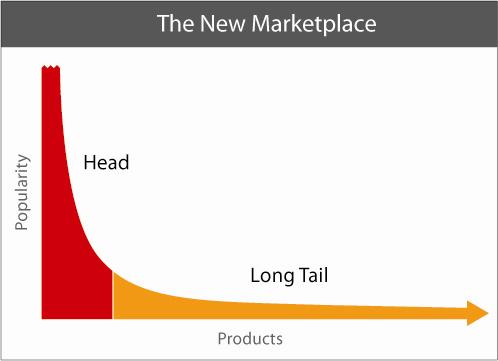
In his epoch-defining book, The Long Tail, WIRED editor-in-chief Chris Anderson explores the statistically rooted theory of the same name. He suggests, “Our culture and economy are increasingly shifting away from a focus on relatively small number of hits (mainstream products and markets) at the head of the demand curve, and moving toward a high number of niches in the tail.” He romances this theory in the context of dominant market forces, including the diminishing physical requirements of distribution and the proliferation of individual content producers empowered by the Internet and new media technologies. His clarifying point is critical,“The Long Tail starts with a million niches, but it isn’t meaningful until those niches are populated with people who want them.” Ay, there’s the rub.

The Democratization of Production and Distribution.

Everything really comes down to the basic economic concept of demand and supply. The difference now is that the cost of reaching niches is reducing dramatically -– thus driving the democratization of production and distribution. In his addendum chapter, Anderson addresses the “the Long Tail of marketing.” The premise of this chapter is that the fragmentation of markets is requiring the fragmentation of marketing. More important, as I have proposed in earlier posts, the user-driven Web is turning the paradigm of traditional marketing communication on its ear.

“(With) individuals trusted more—institutions trusted less—the most effective messaging comes from peers. Nothing beats word of mouth, and as we’ve seen, the Web is the greatest word-of-mouth amplifier the world has ever seen.”

Understanding the Dynamic of Influence.

The integration of the multimedia Web and mobile technologies has forged a brave, new frontier. The medium is really no longer about the message. It’s about the relationship. Therefore, businesses and institutions must shift focus away from managing the message and move toward relating with the influencers. This means leveraging personal affiliations, relationships, and their voices. It also means listening and monitoring through resources, such as:

TechnoratI
Google Trends
Social Networks

The hyperlink is, indeed, the new response device. Traditional metrics, such as audience size and readership are becoming increasingly stale and even irrelevant. Now, response is measured in real-time interactivity—clicks and click-thrus. Action. Anderson says “The hyperlink is the ultimate act of generosity online.” Placing a hyperlink in content signifies tacit endorsement of the associated content and simultaneously gives the author a new brand of authority—the power to refer.

The Power of the Peer.

Given this new focus on the influencer, we as fundraisers could not be in a better place. The development “sweet spot” has arrived. We know that that people give to people, not institutions. And now, the cultural evolution of communication is giving our volunteer fundraisers more power and influence than ever before.

We just need to find the right tools to make them the most successful “askers”— and us the most effective “impresarios” of generosity. Let us know what you think. Ask a question, or leave a comment. Tell us know what you are doing to lake advantage of this rare moment in history.

Elaine Gantz Wright writes about social media that matters. Find her at elgantz@ yahoo.com

Tactics for Tough Times

“It is the nature of man to rise to greatness if greatness is expected of him.” –John Steinbeck

Whether you are large or little, flush or floundering, it’s never too late to chart a course to flourish in the New Year. Even though recovery is still looming as a faint glimmer on horizon, we need to be vigilant about honing our skills to work smarter and make the most of the new economic realities. Here are some scrappy, do-more-with-less things you can do to jump-start your marketing program in 2010:

Contact your lapsed donors. Appeal to them via snail mail or better yet, through email. Reactivated donors can have higher lifetime value than new donors, because they’re already invested.

Express gratitude. Curtailing donor-acknowledgment activities as a means of cost-cutting can be counter-productive–and even devastating. In fact, messages of appreciation will be more potent than ever.

Take risks. Yes, even in a time of uncertainty, new tools can help you differentiate yourself in a sea of solicitations and a cacophony of causes. Social media can help you expand your base and leverage the viral power of peer-to-peer fundraising in dynamic, new ways. Discover exciting ways to streamline your process and empower your volunteers. In this Internet age, the medium is definitely the message, as well as the method!

Innovate. Effective fundraising is dependent on innovation. Everything is testable, and any idea can lead to a stronger program. Whether it succeeds or fails, there is something to be learned. The biggest mistake you can make during tough times is to retreat to a defensive position and make decisions out of fear.

Put the “Donate Now” button on everything. Don’t be shy about the “Donate Now” button. So many schools and universities, in particular, are shy about using this. It’s one of the easiest ways to increase online giving–by asking!!! Some key places to put it include:
• Your homepage.
• The homepage of your online community.
• Every email, every e-newsletter you send.

ENGAGE in social media. If you have not already, create a Facebook page that will automatically post status updates to your Twitter account. (Set that up, too.) And, investigate your LinkedIn groups. You may find that that there is already an active community of support burgeoning on these sites. Build a bridge, and interact with online savvy groups.

Investigate mobile applications. Whether you are providing mobile access to a unique resource, to volunteer offerings, or to giving opportunities, everyone is going mobile. We need to communicate to our donors and alumni where they are — in the palms of their hands — through mobile applications, texting, and mobile-friendly rendering of our communication devices. This will be essential in 2010! According to IDC’s Worldwide Quarterly Mobile Phone Tracker, vendors shipped a total of 43.3 million units during the third quarter of 2009 (3Q09), up 4.2% from the 41.5 million units shipped in 3Q08, and up 3.2% from shipments of 41.9 million units in 2Q09.

Whatever you do, keep trusting — and testing, testing, testing . . . And remember to take time to breathe and celebrate everything you have accomplished this year.

Elaine Gantz Wright writes about social media that makes a difference. Contact her at elgantz @ yahoo.com.

Literary Device


I admit it. I like texting. I don’t know if it is the writer in me, the social media maven, mom, or bon vivant, but I am hooked. It took me a while to embrace it, but I have found the direct access to those I care about quite appealing. I can receive a quick text at work when my son gets home from school—or a little casual banter with a flirtatious friend—without the formality a phone conversation entails. I guess it’s part of the “instant,” byte-sized culture we are creating.

So, I suspect that’s why I haven’t stopped thinking about Stanford University professor Andrea Lunsford’s five-year examination of college students’ writing in the Stanford Study of Writing. From 2001 to 2006, she collected 14,672 student writing samples—everything from in-class assignments, formal essays, and journal entries to emails, blog posts, and chat sessions. What she discovered might surprise you. The reality is that the most popular technological tools and social media platforms continue to receive plenty of sanctimonious slander—from Facebook’s narcissistic drivel, to PowerPoint’s bullet-point prose, to Twitter’s unintelligible prattle. But in true train-wreck fashion, we just can’t seem to stop looking.

As many traditional academicians, such as University College of London English professor John Sutherland have moaned, social media and texting are “dehydrating language into bleak, bald, sad shorthand.” However, the new media guard thinks differently. The truth is that communication is evolving and morphing as breakneck speed, and we are right smack in the middle of maelstrom. Granted, it’s hard to achieve the perspective needed to make sense of it all. Professor Lunsford suggests:

“I think we’re in the midst of a literacy revolution the likes of which we haven’t seen since Greek civilization. Technology isn’t killing our ability to write. It’s reviving it—and pushing our literacy in bold new directions.”

The first thing she found is that young people today write far more than any generation before them. That’s because so much socializing happens online, and it almost always involves text. Moreover, they are writing more than any previous generation, ever—in history. They are immersed in a complex, often confounding, new space where writers and their audiences are now enmeshed. “The consumer has become the producer,” says Professor Clay Shirky. The rules of the game have changed, and communication mores have been literallyturned upside down.

Lunsford pins her findings to the pervasive psycho-sociological trends defining our culture. She says, “More than earlier generations, young people today are aware of the precarious nature of our lives. They understand the dangers that await us. Hence, writing is a way to get a sense of power.” Interestingly, comparing the Stanford students’ writing with their peers from the mid-1980s, Lunsford found that the writing of today’s students is about three times as long today—they have “the ability to generate more prose.” I guess expressing ideas about hard things requires hard words. And when grappling with hard things, “I don’t think it can be worked out in 140 characters,” Lunsford contends. How ironic.

Of all the writing that the Stanford students did, a stunning 38 percent of it took place out of the classroom. Lunsford calls this “life writing.” Those Twitter updates and lists of 25 things about yourself add up. The fact that students today almost always write for an audience—a real switch from the prior generation—gives them a different sense of focus and message impact. It’s almost as if we are narrating our own lives. In interviews, students defined good prose as something that had an effect on the world. For them, writing is about persuading, organizing, and debating. It’s about finding a voice and taking a stand—even if it’s a review of the latest movie.

The Stanford students were almost always less enthusiastic about their in-class writing, because it had no audience but the professor. It didn’t serve any purpose other than to get them a grade. How about texting those LOLs and emoticons? Are they eroding the sanctity of academic writing? When Lunsford examined the work of first-year students, she didn’t find a single example of texting speak in an academic paper.

At the end of the day, texting has it’s time and place. And, there’s the rub. It represents a fascinating dichotomy of communication. It is simultaneously immediate and intimate, yet passive. It finds you any time of the day or night (no matter where you are—except driving, I hope) in the soft, fleshy palm of your hand. But at the same time, it gives you the power to choose when and how you want to respond. To engage or not to engage—the new “text-i-quette.”

Some psychologists warn against this intimate anonymity—that it encourages risky behavior. Elisabeth Wilkins wrote in a blog post that “texting can rob our kids of the ability to interact socially”—diminishing the importance of body language and facial expressions. I think the evolution of email and texting has radically changed the way we communicate and how we express ourselves, but I’m not sure it’s something we can condemn or alter. It simply is. It is the new communications behavior and landscape, which is inextricably intertwined with the technological innovation that enables it.

What do you think of texting and the changing patterns of communication? How are they affecting us as human beings?

Elaine Gantz Wright writes about social media that makes a difference. Contact her at elgantz @ yahoo.com

Organizing Chaos in 2010

Those who ponder the power and possibilities of social media—and its role in our organizations, lives, and culture are all positing predictions for 2010. But, at the end of the day, the big question on everyone’s lips seems to be, “What is the next big thing”? Will it be about catching the Google Wave, the open source document sharing platform—or will our growing mobile obsession drive the success of location-based applications like Foursquare and Brightkite?

Even the experts are unsure. However, I’m not sure forecasting the next Twitter is really the useful question—particularly for those us who focus on leveraging social media in a business context. Most thoughtful professionals I know—particularly in the educational advancement and alumni space—are looking for ways to harness the tools that are already in play more effectively and strategically. Approaching the social media landscape is a little like trying to take a drink from a fire hose—like organizing chaos. We all see the strength of the tools, but we wonder how it all fits and how it will make a difference in our organizations. With this concept as a backdrop, here is how I interpret my crystal ball:

1. Social Media Will Become Less Social.

First of all, I’d like to revisit the term “social media.” There is something about this nomenclature that sounds almost trivial or lacking in substance. I’d like to coin a new term – “engagement media.” It’s more active and deliberate. David Armano said on his Harvard Business School blog recently, “With groups, lists, and niche networks becoming more popular, networks could begin to feel more ‘exclusive.’ Not everyone can fit on someone’s newly created Twitter list and as networks begin to fill with noise, it’s likely that user behavior such as ‘hiding’ the hyperactive ‘updaters’ that appear in your Facebook news feed may become more common. Perhaps it’s not actually less social, but it might seem that way as we all come to terms with getting value out of our networks—while filtering out the clutter.” And I think David is spot on here. We will be looking for more sophisticated, relevant experiences—greater value and ROE, return on engagement.

2. More Enterprise Social Software Platforms Will Emerge.

As an extension of the above development, major software providers, such as IBM, SAP, and Oracle will continue to innovate and launch enterprise-grade social networking and Web 2.0 collaboration applications/suites. Already, Oracle has Beehive; Microsoft enhanced SharePoint with social media functionality, and IBM offers Lotus Connections. Targeted niche solutions will emerge to address industry and stakeholder-specific needs. Currently, many organizations are piecing together solutions with blogs on TypePad/WordPress—or investing significant amounts of time and money in developing in-house communities using tools such as Ruby on Rails.

3. Social Media (“Engagement Media”) Fundraising Will Become More Integrated.

Organizations of all sizes will see the value of fully integrated multi-channel strategies. Using social media channels alone for fundraising will not be as effective as designing coordinated campaigns and communication strategies that include traditional fundraising techniques. This includes email, your website, Google ads, face-to-face events, and managed promotion to the online and mainstream media. Beth Kanter confirms this predication and gives a great example. Just last week, GiveMN, a new online web site that hopes to encourage more Minnesotans to give and help create a stronger nonprofit community for Minnesota, raised over $14 million dollars in 24 hours using a multi-channel campaign.

4. Relevance and Ease Will Become Increasingly Important in Peer-to-Peer Fundraising.

There is no more compelling spokesperson for an organization or school than a passionate supporter. This is the core strength of peer-to-peer fundraising. And there are a range of scenarios—from a class agent soliciting annual fund gifts for his or her school, to a stakeholder requesting donations in lieu of birthday presents or wedding gifts for an organization. In fact, Facebook Causes now offers a birthday wish feature, and we will likely see more peer-to-peer fundraising applications sprouting up in the coming months. In 2010, I suspect donors will demand more meaningful interaction—not so much with organizations, but with recipients and “the mission on the ground.” Epic Change’s TweetsGiving 2009 connects friends around the world with Mama Lucy Kamptoni, who used income from selling chickens to build an innovative school in her village’s community in Tanzania. Last year, TweetsGiving, raised $11,000—with a goal of$100,000 this year.

5. Email as We Know it Will Become Passé.

As Erik Qualman says in his popular Social Media Revolution video, GEN X and Y already view email as passé. And the trend will accelerate—or rather, morph technologically. The New York Times iPhone application recently added functionality which allows a user to easily share an article across networks such as Facebook and Twitter. Many websites already support this functionality, but this next iteration of sharing behavior will gradually replace email list communications—particularly through the exponential expansion of mobile phone adoption. And this will provide renewed opportunities for withering content purveyors, such as traditional newspapers and network television. So, stay tuned. Fasten your seat belt.

It’s likely to be a wild ride! What are your prognostications?

Giving Thanks

We can only be said to be alive in those moments when our hearts are conscious of our treasures.”
— Thornton Wilder

As we approach another Thanksgiving—dining room tables heaped high with the obligatory turkey, taters, and trimmings, it’s difficult to ignore the struggle and challenge so many of us have faced this year. Alas, it’s been a year of more slicing and dicing of budgets and jobs than of crudités. So many have lost so much.

That’s why it is more important than ever that we focus on gratitude—the active process of paying attention to the blessings in our lives and expressing thanks. Granted, this may require a little more creativity and resourcefulness than usual, but it is so important. How powerful it is that seek the silver lining in our most difficult situations and feel genuinely grateful for the opportunities to learn and grow.

Admittedly, that sounds a little pop-psychological. You may be thinking, “Yea, Elaine, easier said than done.” And, I agree to an extent. My year has provided many “learning opportunities.” With an unexpected “professional reinvention,” the vicissitudes of life as a single mom with two teenage boys, a failed relationship, and critically ill family members—2009 has been no picnic.

But I am grateful for so much. The road to self-awareness can be arduous, disruptive, and painful, but it reaps generous rewards. I have excavated buried treasure (and some trash for immediate disposal) from the depths of my own psyche. And, I am grateful to be making new discoveries daily about what I really want and what I possess that I can express to make the world a better place. Wow, with almost a half a century under my belt, I’m finally starting to figure some of “it” out. As treacherous as the road has been, it’s been productive, indeed.

My remarkable boys, faithful friends, family, and church home are all on my gratitude list. I also appreciate you and your interest in my writing. This blog is my passion and my pleasure. It is astonishing. The unpredictable Circle of Life has truly spun me in an exhilarating, new direction this year. And I am convinced that gratitude has helped me. The challenge is allowing ourselves to see it amidst the noise, clutter, and confusion of our lives—to be fully present and consciously aware. It pays to practice gratitude; it can:

Improve relationships. Think about those people who let you know they appreciate you. Doesn’t their appreciation improve your relationships? Be grateful for people, and make sure you let them know how you feel.

Reduce negativity.
It is hard to be negative about your situation when you are thinking about the positive aspects. One of the fastest ways to improve your mood or outlook is to count your blessings.

Improve problem-solving skills. When we think about a problem from the perspective of gratefulness, we open our minds up to new possibilities and connections. We enter a problem-solving situation with an attitude of opportunity rather than challenge or defeat.

Help us learn. Most dark clouds have a silver lining. Every problem can give birth to opportunity. Being grateful for your situation, even if you don’t like it, allows you to be thankful for the opportunity to learn something new.

Alleviate depression.
Try writing five things you are grateful for each night before you go to sleep. You may just start to see a ray of light piercing through those gray clouds. Developing an attitude of gratitude is one of the most important things that you can do for attracting and manifesting the things that you desire into your life.

Life is a series of choices. It is a combination of proportion and perception, and we must be deliberate about consciously choosing gratitude. I surrender my feelings of negativity and despair. I embrace the viability of hope. I actively look for humor, abundance, and joy, and I allow others to reach out to me with their gifts of love, laughter, and healing. I signal the world that I am open, engaged, and committed to fostering the greater good—today and in the years ahead.

Blessings to you and your loved ones this Thanksgiving,

Elaine

Does “Unfriend” Really Have Lex-Appeal?

This morning, Rex Petrasko, my savvy, smart, sincere executive vice president, closed our daily meeting with the announcement that the New Oxford American Dictionary had proclaimed the Word of the Year for 2009 to be “unfriend.” I smiled at him knowingly from across the room, because I had heard the confounding announcement hours earlier on NPR as I brushed my teeth.

When I heard the brief news byte, I paused for a moment, swallowed hard and considered the irony. First of all, how interesting that the Word of the Year would be a social media—even Facebook word. And “unfriend,” no less. How perplexing that the Oxford folk embraced the negative version of the verb-ized noun “friend.”

Unfriend: (verb) To remove someone as a “friend” on a social networking site such as Facebook. As in, “I decided to unfriend my boyfriend on Facebook after we had a fight.”

“It has both currency and potential longevity,” notes Christine Lindberg, Senior Lexicographer for Oxford ’s US dictionary program. “In the online social networking context, its meaning is understood, so its adoption as a modern verb form makes this an interesting choice for Word of the Year. Most “un-” prefixed words are adjectives (unacceptable, unpleasant), and there are certainly some familiar “un-” verbs (uncap, unpack), but “unfriend” is different from the norm. It assumes a verb sense of “friend” that is really not used (at least not since maybe the 17th century!). Unfriend has real lex-appeal.”

Christine, I think I beg to differ. “Unfriend” has a limited appeal, if at all, and it is particularly disconcerting in this age when people are desperate to connect on some level—electronic or otherwise. Friend, blog, text, comment, post, and tweet are all new inhabitants of the morphed communication lexicon. They are all terms for a new mode of behaving—a new way of being—not so much communicating.

I commented on my Facebook page status today that the Word of the Year might be indicative of the dark underbelly of social media. Merridith Branscombe, a Facebook pal and spirited, sassy woman from my Northwestern sorority days, commented, “It is fairly strange that friend somehow transformed to a verb; and that ‘unfriend’ is Word of the Year? I guess it’s not on the underbelly anymore, but in plain sight.

She is absolutely correct. It is in plain sight. We are connecting and disconnecting in plain sight—in front of God and everyone, and “there’s the rub,” as Hamlet said. Social media is less about communicating and more about behaving. At one point, my ex-boyfriend seemed more disturbed about my “unfriending” him on Facebook than about the actual breakup of the relationship. It gives me pause. Are we all more concerned about the virtual ramifications of relationships than the realities? Something to ponder—especially when we are all so hungry for valuable, real, authentic connection, and online experiences that are truly worth our time and attention in this choatic, often superficial world.

More and more, we are defining ourselves by how we interact, as opposed to what we say. The way we describe ourselves is really irrelevant. We are—how we are, as opposed to who we are. Same goes for businesses. Our customers are defining our brands—not vice versa.

“Unfriend” means that we no longer wish the “offending” person to be part of our online inner circles—our intimate online world, our defined universe. Our walls and tweet streams are sacred ground in many ways. They document our inner most thoughts and our profoundest dreams—our vulnerability and our humanity. As I have mentioned in other posts, “ambient intimacy” has come to describe the visceral nature of social media. Considering that an old boyfriend still might be lurking around as a so-called friend feels invasive, almost voyeuristic. But, how incongruent this seems in a word of open-source and “shareware.” It’s a paradox, indeed.

As the social web continues to explode with opportunities for connection and synergy, conversely, the need to maintain personal autonomy and control somehow intensifies. What do you think?

Accounting for Generosity

We forget that there is no hope or joy except in human relationships.
— Antoine de Saint Exupery,Wind, Sand and Stars

moneyOne of my newest colleagues posed a provocative question last week. He actually has no shortage of insights, and I certainly appreciate living in an environment where questions are as highly valued as answers. Indeed, his inquiry is at the heart of what we do. What inspires alumni to give to their alma maters? More broadly, why do we give in general? At face value, this seems like a simple question, but the longer I work in the field of philanthropy, the more I understand its complexities. Actually, a myriad of responses come to mind—to address a critical need, to save a life, a response to the right appeal from the right person at the right time, a passion for a cause, a sense of obligation, guilt, helplessness, or quite simply— we are asked.

Traditional fundraising methods prescribe a deliberate approach built around the carefully managed steps of cultivation, solicitation, and stewardship. I remember hearing a development consultant stating that he could not imagine a better profession. He described an almost spiritual dimension—saying he felt truly privileged and honored to be in the presence of others when they are exhibiting generosity. And I think he had a point.

In fact, I addressed the sacred component of giving today. Though the Church historically and adroitly integrates giving opportunities into its core experience each week, the last quarter of the calendar year provides an opportunity to renew one’s annual tithing commitment. Making the direct correlation between generosity, one’s income, and one’s spiritual journey is quite powerful, indeed.

But research has shown there may also be a scientific component. I was fascinated to see the results of a study by Paul Zak, a neuroeconomist at Claremont Graduate University. The concept of a “neuroeconomist” is intriguing in its own right, but his work links the trait of generosity with oxytocin, a hormone released by the brain in response to social stimuli. The study showed that participants who were given oxytocin gave significantly more money to a stranger than participants who took a placebo. Whether or not there is a “fundraising drug,” (what a concept?) I think the epiphany here for all of us in the social media space is that meaningful, real engagement opportunities can create an environment that nurtures of generosity and an increase proclivity to give.

“The hormone causes a general feeling of attachment to other people, even strangers,” Zak says. That may help explain why people donate to victims of natural disasters or to others who are in need. “Oxytocin is a social glue that holds us all together and makes us care about other people,” says Zak, who has shown links between the hormone and trust in past research.

“If you have enough nurturing, if you’re in a safe environment, you might be more likely to release oxytocin the next time you encounter a positive social stimulus,” Zak says. Interestingly, he says that about 2% of people constantly have oxytocin being released by their brains, so they stop reacting to it. “Those people lack empathy,” Zak says. Although they can still learn appropriate behaviors, the reactions are not natural for them. Ha! I think I have met some of those people. Oxytocin means “swift birth” in Greek.

Whether you consider the hormonal reaction or not, it really all comes down to relationships—more about the intangible than the tangible. It is often first an emotional impulse of the heart, followed by a logical justification. We are all interconnected as part of a larger human web, and I’m not necessarily talking about the WWW variety here. We are human beings driven by:

Compassion. Regardless of cultural and familial experience, people everywhere are moved to respond when others are in need.

Pleasure. Brain scans confirm what we experience feeling of pleasure when we give. In a sense, it’s really “hard-wiring.”

Habit. If we watched our parents give, we likely internalized that impression. We understand—on even an unconscious level—that this is what good people do.

Belief. Whether we consider charity to be based on religious beliefs, philosophy, or universal values, we as humans recognize an essential imperative to take care of each other. These ideas are larger than self-interest and benefit.

Responsibility. When others are hungry, sick, frightened, without shelter and livelihood our society is put at risk. Our education institutions are driving solutions to many of society’s most pressing issues.

Legacy. When we give we know that we influence the future, sometimes only immediately and sometimes for a very long time. By creating a memorial endowment fund we keep our name and memory alive in the community long past the obituary.

The unknown. We may even have unknown reasons for giving—some even unknown to ourselves.

What do you think? And how is social media impacting generosity?

Elaine Gantz Wright writes about social media, fundraising, and other communications phenomena. Please post your comment below and join the conversation.

Hire me: elgantz@ yahoo.com.