No more waiting in the weeds: Make time to grow your social media garden

ElaineGantzWright’s blog is for people interested in using the Web and online marketing to drive social change. Elaine covers social media for nonprofits, philanthropy trends, online giving, cause marketing, random life musings, and more. Find her at SocialFuse.

gardenI recently read Josh Catone’s Mashable post on the “5 Essential Tips for Promoting Your Charity Using Social Media.” I applaud Josh’s concise synthesis of the basic-level concepts defining social media. But I really think it’s time to help organizations get specific and tactical. We need to move from musing to mastering. Many of the organizations I advise are still befuddled and overwhelmed by social media. They seem to view social media as some separate, daunting frontier they need to confront and invade. However, in many ways, social media is really just a new, better way of helping nonprofits do what they do best – engage. It’s made for us! We need to move the conversation from “Why should we?” to “How should we?” It’s now more of a functional shift than a philosophical one. Josh’s recommendations are well-taken and commonly held. Yet, here are some additional thoughts to ponder to take your strategy to the next level:

Build a Plan and Work It.
Josh instructs that you’ll get a much better return on your investment in social media if you take the time to actually engage your followers, friends, and constituents. He warns that we should not just broadcast information. We should consume it, as well. Indeed, this is the way social media works, but the question is – How do we work this? To foster relationships, organizations need to officially delegate responsibility for regular care, feeding, and cultivation of online communities to staff, trained volunteers, or perhaps, an outside agency or consultant. Simply creating a Facebook fan page or Twitter profile will not produce results. Start by assessing the following:

• Your Goals – SEO, PR, traffic (to drive awareness? advertising click-thrus? conversions?)
• Your Audience – Where do your constituents/stakeholders live? What do you want them to do?
• Your Resources – You, interns, staff, agency, consultant? Budget? Communication tools?

Social media is organic – much like a garden which must be regularly tended and even weeded. It’s all about activity and careful attention. Here are some specific tasks to help your garden take root and thrive:

• Create and update blogs and tags at least once a week.
• Respond to all blog comments within 24 hours.
• Pose questions in and respond to queries in relevant Linked In discussion groups.
• Tweet at least once daily and retweet (RT@) content relevant to your mission.
• Respond to Facebook comments promptly, and update Facebook status at least daily.
• Post high-value content, such as videos, articles, and blogs across key social media platforms.
• Identify the A-List blogs and cultivate positive relationships with as many as possible to persuade them to blog about your issue. Or guest blog for them.
• Drop html links with target anchor text related to a specific call to action, relevant product, or web resource for an additional SEO lift and traffic increase.
• Start and update a custom, branded community such as Ning to drive engagement and enhance SEO on your own site.

Create a Human Persona.
Social media is your opportunity to put a face on your organization and to humanize interaction. Those who are immersed in social media are not really looking for a press release or canned “mission statement.” They are hungry for intimate, behind-the-scenes, authentic access. Think about ways to make the private public. This is the messaging that will attract and embrace.

Create Valuable Content.
Josh recommends sharing only the highest quality content. This is key. I was speaking with a friend just today about the challenge of being inundated with information. With so much competition for the attention of constituents, you need to make sure the content you publish and share is relevant and real. So, be sure to consider the context and the medium. Perhaps, consider experimenting with videos on your website – feature video testimonials from donors and/or recipients. Social media is about storytelling – truth that touches the heart.

Create Community Instantly
Social media gives you the power to spread information quickly. Using social media platforms to issue a call to action online can trigger viral campaigns rapidly, economically, and effectively – enabling you to reach new audiences. Plus, using tools, such as #hashtags on Twitter, can help you create improvised communities around issues on the fly. Hashtags are a community-driven convention for adding additional context and metadata to your tweets. They’re like tags on Flickr, but you add them directly to your post. You create a hashtag simply by prefixing a word with a hash symbol: #hashtag. Read more about them on Beth Kanter’s blog.

Create a Social Media Culture.
Just as everyone in a healthy organization is a salesperson, everyone in your organization should help cultivate your social media presence. As Josh says, if everyone at your charity is connecting with people on Twitter and Facebook, you’ll be able to engage many more people than if just a couple of folks are tasked with using social media tools. But, in the realm of the tactical, you should not expect this to “just happen magically.” Create a social media policy – even if it consists of a simple public relations calendar of messages, events, or campaigns to discuss organization-wide. Include your staff, donors, and even recipients. And don’t forget your board of directors. Nonprofits are constantly seeking ways to engage boards in resource building, and social media is a great way to involve boards of directors – especially when it comes to tapping into their potentially powerful spheres of influence.

“That is well said,” replied Candide, “but we must cultivate our garden.”
-Voltaire

How are you cultivating your social media garden? What’s helping you thrive? Let me know if you need help planting the seeds. Find me at SocialFuse.

The New General Store

general2Think back to the days of the old general store. We knew our merchants in the neighborhood personally—around the corner and down the road. We knew exactly what they sold and where they stood. They were members of the community, and they earned trust through referral and association. Enter the industrial age—efficiency trumped personalization. People didn’t mind where they shopped—as long as goods were cheap and abundant. Soon, the suburbs emerged, and the impersonal, monolithic box stores were born. In many ways, we are now coming full circle. Perceived value of anonymous, depersonalized transactions is waning.

Consumers are once again seeking personalization, even intimacy, from business interactions—large and small. In terms of accountability and integrity, marketing spin is no longer enough. It can even ring hollow. The Internet has rendered a heightened expectation of veracity and transparency. Now, we are quick to question the authenticity of advertising and the sincerity of sales pitches. Once again, consumers want to know the store’s owner, the business dealings of the board’s president, and the organization’s endowment investment practices, etc. Focus has returned to key customers and core consciousness. The beauty of social media is that it allows us to accelerate cultivation of these open, honest relationships. Through social media, businesses can make themselves more accessible, more personable, more real, and almost instantly differentiate.

Integration. ROI. Relevance. These are all terms buzzing around the implementation of social media. My niche is nonprofits, but the same questions are swirling about for small businesses, as well. I hear many people say they need to be able to measure ROI and justify the expense. The concern is understandable in our strapped economic climate, but the truth is that we can’t afford to ignore social media! It is more than just the shiniest tool in the drawer or a trend relegated to eager interns. It’s becoming the new communication standard –- expected and demanded by an enlightened, savvy class of consumers and/or donors who require personal, real-time engagement, instant response, and interactive branding.

And it’s applicable to every type of business. Cafes, retail stores, professional services, and grassroots nonprofits can use social media to build online reputations, propel trust to new levels, and jettison concerns about the time required to manage the process. It’s a dance—not a speech. In fact, the magic is in the mambo! Here are 4 essential ways to get started today:

1. Think locally.
Consumers are using local social networks, such as Yelp and The Examiner to find businesses and make recreational decisons. And they also get the “social proof” they need when making choices. They use comments and reviews to determine the “best” listing and make the buying decision. Because these sites attract people ready to make a decision, small businesses can see a great return from local social networks. Many of these sites will let business owners “claim” their listings and add information, such as phone numbers, store hours, menus, etc.

2. Create on online destination and sales pipeline.
When you think about social media, you may focus on Facebook, Twitter, and other social sites. You may not immediately consider a dedicated presence on your own site. It makes enormous business sense to aggregate your social profiles in one place. And, remember to make your profile decisions carefully. Choose your “tent posts” strategically. Don’t pepper the world with a plethora of profiles. In fact, consider creating a blog or custom social community on your own site. Why push your consumers to connect with you on other sites, but not give them a reason to visit yours? Building and writing a blog may seem time-consuming, but it creates a way to connect with users through your own web address. Additionally, creating useful content such as how-tos or industry insights will attract and engage customers. For business owners or nonprofit execs who are daunted by the prospect of regular blog updates, build a “Connect” or “Community” page. This offers readers a way to find your business’ most active profiles and join you on those social sites. The page could also include a short bio or how you use each social site. Giving consumers a reason to visit your site is extremely important. A blog or “social hub” can pull consumers to your site and directly into the sales process.

3. Jump into Facebook and Twitter.
Everyone is talking about Twitter and Facebook, but you may be stumped about how to actually get started. With Twitter, you can cater to your customer or donor needs, requests, and complaints instantly. In a world where everything needs to be done yesterday, a quick response can create a lifelong customer and fervent brand advocate. On Facebook, a Fan Page allows a business to visualize and build a community, similar to Twitter. However, unlike Twitter, you can add and customize a great deal more.

At the very least, you should update your Fan Page “status” to keep consumers informed and engaged. A more advanced technique would be to add things like coupons or Google maps directions to the storefront.

4. Discover crowdsourcing.
Finally, consider creating a custom wiki, which harnesses the phenomenon called crowdsourcing. In other words, use your customers to give information to other consumers. Wikipedia is often cited as a successful example of crowdsourcing, despite objections by co-founder Jimmy Wales to the term.

The easiest way to do this is by creating a wiki for your FAQ or Customer Service knowledge base. Let your consumers enter the problems they’ve had via a public forum (the wiki), and provide your responses publicly as well. Although showing problems may seem backwards, it’s a very effective way to retain customers and generate new sales in the new context of social media.

Consumers know that mistakes happen, and they now expect their questions will be answered quickly. Also, with a public wiki, customers can reference response to the concern, saving time for both you and the customer. With minimal moderation, a wiki can build trust in your business and make your customer service more efficient.

The contextual shift is about engaging in dialogue, and opposed to delivering a message. How are you making the transition? Let me know.

The Art of Social Media

imagespalette1 As the cacophony of social media voices continues to intensify around nonprofit causes, the world of arts and culture is really just beginning to embrace the potency of online engagement tools—in provocative, new ways. For many organizations, the experience is exceeding online engagement and becoming what I call “meta operational” – creating the illusion of participation in the core functional tasks organizations. This creates a dynamic, new way to thinking about participation and volunteerism—especially for those more casual observers or inquirers. As we say in the performing arts, we are finding new ways to break down the fourth wall.
Nonprofit blogger Beth Kanter said in a recent post that “the internal is the new external. “ The line between internal and external discussions (and functions) is thinning. We are moving toward a real-time operational transparency. And this concept is giving birth to innovative paradigms of collaboration with external audiences. For example, anyone can now participate or contribute to a strategic planning discussion or exhibition scheduling session which is shared online in a program’s blog or community forum.

Artists and Art Museums
Another example of this is the The Extraordinaires iPhone Application I discussed in a blog post a couple of weeks ago. With the microvolunteering app, individuals can actually participate in the organization’s central curatorial tasks. What a notion! With The Extraordinaires, one is invited to do the academic work—actually tagging and categorizing images for the Smithsonian or cataloging images for the Brooklyn Museum. In addition, the Brooklyn Museum has also introduced a $20 annual “socially networked museum membership.” It’s called “1stfans” and offers exclusive event invitations and access to artist-created content on the protected Twitter art feed (@1stfans). And the “Tag! You’re It!” introduction to applying keywords to their images. A key factor in this new mindset is that leadership must be comfortable with discomfort. “The leadership of the organization understands that social media and connectedness has an impact on the organization and they need to embrace it,” Kanter asserts.

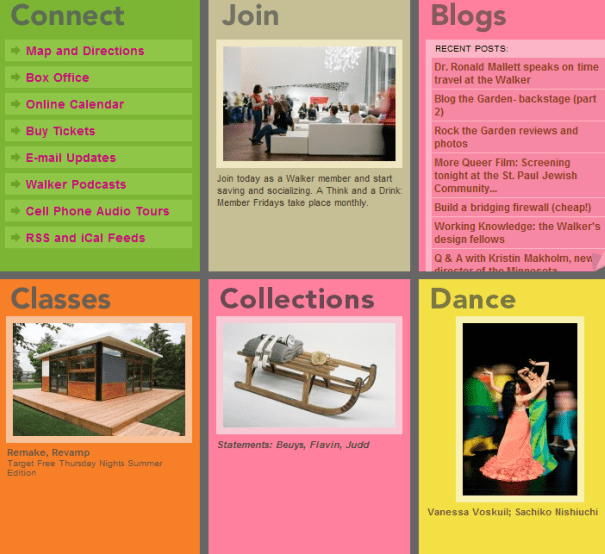
Other artists and museums are using social media thoughtfully and in big, bold ways (but not necessarily requiring big budgets). They’ve capitalized on the audiovisual nature of the Web to showcase the storytelling and community-building aspects of their work. For example, emerging art spaces can learn a great deal from Minneapolis’ Walker Art Center, where the exhibitions aren’t the only cultural experiences. Visitor options at WalkerArt.org include “Connect,” “Join,” and “Blogs” with content on design, education, new media initiatives, and visual and performing arts. They also publish art history and analysis podcasts on the museum’s iTunes U channel, and curators’ comments are available real time through the mobile system Art on Call.

walker
National Symphony Orchestra’s “Tweet Suite”
And in the performing arts realm, the “Tweet Suite” experiment is getting lots of buzz. The National Symphony Orchestra recently experimented with tweet tactics during Beethoven’s “Pastoral” Symphony at Wolf Trap. Though many were dubious, the orchestra tweeted notes of explanation from conductor Emil de Cou during the performance. (Example: “In my score Beethoven has printed Nightingale = flute Quail = oboe Cuckoo = clarinet — a mini concerto for woodwind/birds.”) Those interested sat in a designated area on the Wolf Trap lawn with their BlackBerries, iPhones, or other mobile devices. They followed @NSOatWolfTrap Trap to gain a new perspective on the score. And, you could also follow along without actually being at Wolf Trap at all. Though there has been a crescendo of moans in response from classical purists to the techno-intrusion into the traditional concert experience, innovation is important to integrate to insure a continuing appeal to audiences in a world full of so many voices and media competing for our time and attention.

What so you think of Tweet Integration and Meta Operation? Let me know.

Finding Faith in Social Media

Mo Ranch 2009
Mo Ranch 2009

Theoretically, I know that church is much more than a building or a weekly activity on the to-do list. But no other experience proves that more clearly than my annual trip to Mo Ranch outside of Kerrville, Texas in the pristine splendor of the Texas Hill Country. Though I consider myself an inveterate urban gal, there is something so ethereal, so transformational about the majestic beauty of the grand, sweeping vistas of the Presbyterian Mo Ranch retreat. Just thinking about it brings tears to my eyes—even as I type this.

Leaving behind responsibilities, have-tos, and the clanging of electronic gadgets is actually no easy task (particularly challenging for my teenagers). No Internet, no cell phones, no WiFi—but, oh, some amazing connections—of the human kind. I relished the hours of talking and listening, of singing and laughing, of weeping and praying. One of my fellow retreaters suggested this environment gives God the space to utter, “Can you hear me now?”

The stillness reminds us of the clutter and clatter we muddle through every day—increasing in density and volume with every new Tweet, Ringtone, and Poke.

But, it’s our reality—and our opportunity, really. Just as there is a time and place for sharing the view of a thousand glittering diamonds strewn across the deep dark blanket of a Texas night sky, there is also a place for connecting in new, unexpected ways through the mysteries of new media.

I have been thinking a great deal about using social media to enhance my church community and perhaps the lives of other congregations. I see it as a natural way to build the community of God with bold, new voices— beyond Sunday morning and the bricks and mortar of the tangible place called church. In her article, “The Church on Facebook” in The Christian Century, Lenora Rand makes a compelling argument on behalf of virtual community for churches. As she points out, “Church isn’t where you meet. Church isn’t a building. Church is what you do. Church is who you are.”

Church is carrying out the work of God in our lives, homes, and communities. I am so proud of the work of First Presbyterian Church of Dallas—serving about 1,500 meals a day through The Stewpot in conjunction with The Bridge to those in desperate need, as well as sponsoring other youth and adult-driven community service projects around the city, the country, and the world.

On Sunday morning each week, we meet with others of like mind and beliefs to worship; however, social media tools such as Facebook and Twitter can provide a valuable, even profound extension of our community-building opportunities. In our hectic world, we can look to Facebook, Twitter, or other online communities to provide a safe place for revealing our truths, sharing our frustrations, supporting each other in sorrow and joy, and even praying for one another in specific ways. We are hungry for a place to share our burdens and offer shoulders.

Often, the authenticity and truth of much of the communication on Facebook and Twitter astounds me. Admissions can range from cries of hopelessness after a layoff, to the anguish of life upheaval after divorce, to the utter joy of a child’s first steps. It’s a way to connect, engage, and soothe frayed emotions, weakened bodies, and aching hearts—woven into the fabric of our over-scheduled days and sleepless nights.

Last week, I wrote about the concept associated with Twitter called “ambient intimacy.” Commenting on my blog post, one of my readers clarified that blogger Leisa Reichelt originally coined the term. Reichelt says, “Ambient intimacy is about being able to keep in touch with people with a level of regularity and intimacy that you wouldn’t usually have access to, because time and space conspire to make it impossible.”

Some may say—who cares?

But she contents, “There are a lot of us, though, who find great value in this ongoing noise. It helps us get to know people who would otherwise be just acquaintances. It makes us feel closer to people we care for but in whose lives we’re not able to participate as closely as we’d like. Knowing these details creates intimacy. (It also saves a lot of time when you finally do get to catch up with these people in real life!) It’s not so much about meaning, it’s just about being in touch.”

Social media a powerful, intimate way to share the human experience—and perhaps even the Holy Spirit as we reach out to touch souls in an evolving, increasingly complicated world.

There are so many contradictions
In all these messages we send
(We keep asking)
How do I get out of here
Where do I fit in?
Though the world is torn and shaken
Even if your heart is breakin’
It’s waiting for you to awaken
And someday you will-
Learn to be still
Learn to be still

from “Learn to Be Still,” The Eagles

The Tweet Life: Ambient Intimacy and other Epiphanies

twitter6To say Twitter is hot is quite an understatement. In a world thirsty for leadership, everyone seems to be following these days. In the past week, I have attended some interesting presentations on the Internet and making sense of social media for business. It’s a reality and a resource—no doubt, but there is still rampant confusion about how to optimize it. I am very interested to know how you view social media and use it.

I met a true social media master this week—Ben Smithee. He is an astute Gen Y entrepreneur steeped in the savvy of social media—particularly for market research. He says no one has ever called him a guru, but I certainly would. Ben has an impressive grasp of all the latest and greatest tools. Regarding Twitter, he recommends we not Tweet as a business, but as a human voice. Make your messages personal and conversational—not institutional or programmatic. Interact with customers, donors, or clients as individuals, not a solid mass. It’s Communication 101. Make it intimate. Vulnerability is where real connection happens. In fact, I absolutely loved Ben’s term for social media—“ambient intimacy.”

And then, it hit me! That’s the magic of social media. It permeates our everyday lives. Call it habit or even addiction, as some have. For many, social media can become part of their everyday unconscious impulses. That’s why we need to pay attention to this stuff. We can actually use Twitter and other social media tools to enhance intimacy with patrons, donors, customers, or clients by humanizing your missions and our value propositions. Focus on the anecdotal—on stories with authentic fiber, as opposed to carefully crafted messages. It takes so much more than an understanding of the tools and technology that power social networks to inspire change and build long-term, meaningful relationships. You must immerse yourself in the conversation.

You are the personality and the soul of the brand you represent. Think of social media as the page where we compose digital poetry to inspire. These tools are born from technological advances, but they are rooted in the most basic elements of human communication—conversation, curiosity, caring, and connection. I guess you could call them the four “Cs” of social media—a girl’s (or boy’s) “second” best friend, I suspect. Here are a few more tips and concepts for your Tweet Sheet:

Tweet. Message to your followers.
Retweet. Share status messages on Twitter. It’s a great way of building relationships.
@Replies. Direct a message that is available to all. Great way to lift others up.
#Hashtags. Create ways to search and group information/initiatives/activities.#MoRanch
Promote your blog or podcast. But try to do it conversationally. Ask people what they think or pose a rhetorical question. Don’t just SPAM the URL. Also, be careful about headlines or questions that are TOO provocative. I have learned this the hard way. Sometimes it’s best to leave your clever copywriter hat in the closet and just be REAL.
Follow a specific cause of entity. Consider finding the right people tweeting about that cause or entity, and build a blended dashboard tool such as Hootsuite.
Understand how people are really using Twitter. Monitor the @ replies, and see how they interact with others. Some folks use Twitter like a megaphone, and others use it like a walkie-talkie.
Make business connections. As always, listen first. Learn more about the person, follow their links, read their blogs, and get to know them. As I have said in the past on my blog, it’s a courtship. You date before you marry. In this space, you listen, respond, and participate—before you pitch or solicit!
Create a tweet strategy. Instead of tweeting “what are you doing?” try “What are you passionate about?” The answer to that could be very interesting and revealing.

And for nonprofit causes, hashtags have become an effective tool in building awareness and motivating action. They make it easy to search and identify a particular trend. Blame Drew’s Cancer http://blamedrewscancer.com/# (hashtag: #blamedrewscancer) is a great example. Drew Olanoff recently contracted Hodgkins Lymphoma, and launched his campaign. The tweets are pulled into http://www.blamedrewscancer.com with the goal that their sheer volume will trigger a large donation from a nonprofit organization. The site recently announced that Livestrong will be a partner.

So, get creative! And let us know—what’s working for you? Follow me.

How are you holding on — in the meantime?

The Rollins Philanthropy & Leadership Center recently released the findings of its 2009 Nonprofit Compensation and Benefits Report. The report compiled data on more than 8,300 individual salaries and categorized into 121 job titles for 145 nonprofit organizations in Central Florida and found that male CEOs/executive directors of nonprofit organizations earn significantly higher pay than their female counterparts on average. According to the report, the average annual compensation for male CEOs/executive directors was $110,962 versus $80,987 per year for females. “While more of the surveyed CEOs/executive directors are women, there are more males in the CEO/executive director positions at the largest organizations,” said Margaret Linanne, executive director of the Philanthropy Center. Margaret added that these numbers lined up with recent nationwide data released by a similar study conducted by The Nonprofit Times.

I hung up the phone after speaking with Margaret and thought, “How grim.” I consider myself a glass-half-full, optimistic person most days, but I’ve been having trouble mustering the good cheer. This story makes me think of my own situation—in transition once again—personally and professionally. I am a seasoned career professional and a woman with many blessings. I have invented programs, raised millions, and changes lives, but my path has encountered many challenges lately. The social media start-up business I felt was my calling recently faced difficult choices—a layoff of the core team due to budget cuts. The pain of a vision, derailed.

Ordinarily, such circumstances would not thwart my resolve, but the uncertain economic environment is disturbing in new, pervasive ways. I can think of more than a dozen bright, intelligent, accomplished women in their forties and fifties who have been relieved of their significant responsibilities in the past six months—in for-profit and nonprofit environments. Margaret surmised that the male bias still lingers in private sector and nonprofit board rooms across the country that—”women don’t have to work,” because their husbands are the making big salaries or because they are raising the children. But I am here to tell you that the women are typically doing both jobs these days. Where do we find the energy?

And many reports say that males are feeling the brunt of the economic downturn. A July 16, 2009 Wall Street Journal article reports, “The 2.3 percentage-point gap between men’s June unemployment rate of 10.6% and women’s 8.3% rate is near the highest it’s ever been since records started being kept in 1948. The gap first hit two percentage points in March this year, and the 2.5 percentage-point gap in May was the highest ever. The overall unemployment rate rose to 9.5% in June, from 9.4% in May. The economy lost a higher-than-expected 467,000 jobs in June.”

As the single mother of two teenage boys, the reality of waning male productivity is as disconcerting as the abhorrent gender compensation gap. About two out of three men I encounter seem to be chronically unemployed, underemployed, or nursing a sense of entitled malaise. Not sure what in the heck is going on in our culture, but I suspect we are on the verge a course correction of unprecedented magnitude and disruption.

Seeking solace, I revisited one of my favorite books recently—In the Meantime, by Iyanla Vanzant. It is an intimate, touching book about transition of the heart—the process of moving from one period in your life to the next—managing monumental changes in love, life . . . everything.

Iyanla writes: “The presence of love is a healing power. The effects of this healing are what we are all born to discover and experience in every aspect of our lives. It is sometimes difficult to realize this, because in the meantime, we are not getting the love we want in the way we want it. The meantime is often a time of vagueness. You are experiencing a vague anxiety that you cannot quite pinpoint. It’s in your head. No, your chest. No, your heart. Sometimes that something is sadness. You are walking on a tightrope, about to fall. You are trying to hold on, to stay grounded, but slowly, bit by bit, you realize that you or your job or your relationship is falling apart. In the meantime, just when things look like they are falling apart, they are actually falling into place—the divine place for everyone involved. When you are in the meantime, you are in a time of healing preparation. You are being prepared for the grandest experience of your life—unconditional love and light. In the meantime, you must be willing to endure the process of felling vague confusion and helplessness. Remember, however, the meantime is not permanent. It is a healing process.”

I find Iyanla’s words comforting right now—at a time we all need to examine the truth in our hearts as we reinvent our expectations and our lives. We all need to find a way to hold on—in the meantime.

Anne Lamott, another one of my favorite writers, says, “Man is born broken. He lives by mending. The grace of God is glue.”

What are your thoughts about keeping your balance?

Tweet Surrender: The Truth about Twitter

tweet_twoThe decibel level of Twitter buzz only continues to crescendo. Harvard Business School is even studying the complexities of Tweet-ology. A Harvard MBA student examined the activity of a random sample of 300,000 Twitter users in May of this year—to try to understand the phenomenon that is Twitter. We hear it referenced almost daily—and more and more, you can follow just about anyone or anything on Twitter, but what’s really going on? And this begs the question—just how do we make it work for us?

Continuing along my own journey of social media comprehension, I have to admit I was startled by this recent data—especially in comparison to what I know about other popular social media sites, such as Facebook. The researchers discovered that 80% of those sampled were “followed by” or “followed” at least one user. By comparison, only 60 to 65% of other online social media site members have at least one friend (measuring these stats for sites at similar levels of development). This suggests that entrenched, active users really do understand exactly how Twitter works. (Unlike much of the non-Web 2.0 world.) The initiated get it — not really too much of a revelation, methinks.

However, it’s the metrics around gender behavior that particularly intrigue me. Although men and women follow a similar number of Twitter users, men have 15% more followers than women. And, men also have more reciprocated relationships, in which two users follow each other. This “follower split” suggests that women are driven less by followers than men, or perhaps they have more stringent criteria for reciprocating relationships. This seems somehow counter-intuitive, though—especially given that females hold a slight majority on Twitter—45% are men, and 55% are women.

Even more enlightening is— who follows whom:
• A man is two times more likely to follow another man than a woman.
• A woman is 25% more likely to follow a man than a woman.
• A man is 40% more likely to be followed by another man than by a woman.

This cannot be explained by different tweeting activity, either, because both men and women tweet at the same rate. These results are remarkable in light of previous social media research. On other social networks, most of the activity is focused around women. Men seem to follow content produced by women they do and do not know, and women follow content produced by women they know.

Generally, men receive comparatively little attention from other men or from women. The researchers conjectured that perhaps men and women find the content produced by other men on Twitter more compelling than on other social networks. And maybe, men find the content produced by women less compelling because of the lack of photo sharing, detailed biographies, etc. After all, men are visual creatures.

Or could the cryptic nature of the 140-character-post limit and truncated URLs inhibit more meaningful sharing—that women often prefer? It’s a thought-provoking question.

Overall, Twitter’s usage patterns are also very different from a typical online social network. On Twitter, there is a small, very active user group. Specifically, the top 10% of Twitter users accounted for over 90% of tweets. Oh, there’s that old 90/10 rule again! Fundraising 101, indeed. On a typical online social network, the top 10% of users account for only about 30% of all production.

From this perspective, Twitter is actually more of a one-way, asynchronous communication vehicle than a two-way, peer-to-peer network. Perhaps nonprofits can harness the platform for a new way of crowd fundraising? Worth considering. The leaders initiate and the followers acquiesce. Hmmm . . . a whole new way to think about the social web? Perhaps a new social science. I wonder.

What do you think? @ellagantz

Will microvolunteering have a macro impact?

iphone_200
I was very intrigued by the latest social media philanthropy trend I saw posted by NPR on my Facebook page—The Extraordinaires, a snazzy, new social media enterprise that delivers microvolunteer opportunities to mobile phones that can be done on-demand and on-the-spot. The article begins – “Got five minutes? Got a cell phone? Want to do good?” What a concept—weaving volunteer activities into the fabric of your busy, over-programmed day. Interesting concept, but does it make practical sense? When you are waiting at the doctor’s office or in line at the grocery store, might you have time or focus to translate an email newsletter into Spanish—or figure sum-of-the-years-digits depreciation on the purchase of a new copier? I wonder. It’s a great concept, indeed—multi-taking at the highest level of win-win efficiency.

Upon download, I realized the opportunities offered were almost universally photo-related—tagging images for the Smithsonian or cataloging images for the Brooklyn Museum. My mind was racing with other options or opportunities. Still, I was a bit bewildered. The app asked that I describe what I saw—one session asking me to tag what appeared to be 19th century French Genre paintings. Now, I’m thinking this is a bit freewheeling for a museum. Luckily, I took art history in college, but I’m not so sure I would trust the random, crowdsourced public to accurately catalog these esoteric works for posterity. Definite fact-checking and review required, indeed.

As I hit submit, I suspected that it was less about the task at hand, so to speak, and more about the experience. It’s kind of like taking one of those Facebook quizzes. It’s fun and enlightening in a pseudo-informational sort of way, but the value is questionable. However, I was surprised that there seemed to be no data capture—no way of engaging me further after my “micro” interaction. There was just a very cordial thank you for “making the world a better place.” So, the ongoing social media question looms—how do we bring those touched through casual encounters such as an iphone tagging exercise into our cultivation universes?

Extraordinaires co-founder Jacob Colker, 26, says, “We hope people might look differently at that ride on the bus and not just play video games.” He continues, “Microvolunteerism is perfectly suited for the Millennial Generation. They are used to text messaging, MySpace, Facebook, get-in, get-out, instant gratification. For them, going out and cleaning up a park—that’s not necessarily attractive to them.” So, is microvoluteerism the new media equivalent of a one-night stand? No commitments . . . no strings? I guess we’ll have to stay tuned!

I cringe to think the entire paradigm for volunteerism is shifting to micro tasks and instant gratification. I prefer to see this as fresh, innovative concept yet another option to attract “followers” and “fans.” I am reminded of the mission trip my 17-year-old son recently took to northern Michigan. The group of 35 students spent a week renovating a deteriorating campground for economically disadvantaged youth. They built Adirondack chairs, sanded fences, and painted cabins. They got their hands dirty and their hearts engaged. No cell phones were allowed. And, the gratification may not have been instant, but it was most certainly—genuine.

What do you think about microvolunteerism?

From the Bazaar to the Cathedral

Social media = the bazaar

I had an energizing partnering conversation with a dynamic nonprofit consultant this week. It’s one of the things I love most about my work—networking and brainstorming with passionate, bright professionals about maximizing support of nonprofit organizations. Carlo Cuesta is part of a firm based in Minneapolis called Creation in Common. Love the notion. And, I love the Twin Cities, because I spent my salad days (in addition to most of my snow days) there working for the glorious Guthrie Theater—one of the foundational forces of our nation’s regional theater movement. In its vision statement, CIC states, “Engaged collaboration is the ultimate method in which to create vibrant communities working in harmony toward a shared vision. Knowledge is in constant motion and is formed through playful interaction, the active exchange of ideas and concepts, and the testing of solutions that lead to enlightening truths and courageous failure.”

This is a perfect description of social media.

There is much lively banter and conversation across the various Web 2.0 groups I frequent about nonprofit engagement in social media. Do nonprofits get it? How should they do it? Are they really ahead of the private sector curve? Does anyone know how to measure ROI? Why should they spend the time? How do they integrate into my communication plan?

All of these are valid questions—and worth answering as soon as possible. But one post I read definitely sums up my feelings. Richard Lewis, a new media pro, says, “The most important consideration for the use of social networking is that if you choose not to participate, you are still part of the discussion, but you just do not have a voice.” It’s all about finding your own, distinctive, effective voice in the sometimes overwhelming cacophony.

Actually, many analogies are emerging around social media— “the cocktail party,” “circus,” etc. But, I really liked Carlo’s concept – “the bazaar.” Marketing has been carried out to date more “cathedral style.” Organizations traditionally deliver messages as if we were speaking to a focused, almost sedentary audience—their congregations, if you will. The social media landscape really is a more like a flea market or a bazaar. It’s a free-for-all of experiences and ideas with the incessant, media-driven competition for attention and interaction. It’s about distraction and short attention spans. Carlo contends that our task as marketers is create that bridge or portico—that provides a path into the organization’s “cathedral.”

What a useful image! Yes, we do need to lead friends into our figurative cathedrals. Perhaps we can do that more effectively by offering opportunities to engage and converse on our very own web sites. Through our own hosted, customized communities?

But, we also need to meet the fish where they swim. Such as:

• Twitter — micro-blogging
• Flickr, Picasa — photo-sharing
• LinkedIn, Facebook — social networking
• YouTube, Vimeo – video-sharing
• WordPress, Blogger, Typepad – blogging
• Slideshare, YELP – Info-sharing

The context has changed—and to succeed, our tactics must be decentralized, as well. We are communicating and responding in real time—on the fly and with a whole new mojo (as my teenage son would say).

So, it seems our goal in the long run is to cultivate and empower these various communities of affinity—whether they emerge in our own cathedrals—or in the hearts of those we serve in the remotest corners of the vast virtual universe.

What are your thoughts?

Nonprofit Social Media Savvy Outpaces Private Sector

Though nonprofits are often seen as late adopters on the technology frontier, a recent study conducted by the University of Massachusetts Dartmouth Center for Marketing Research indicates quite the contrary with regard to social media. Results shows nonprofit groups are actually well ahead of their brethren for-profit businesses in their use of social-media tools such as Twitter, Facebook, and blogs. The soon-to-be-released study found that 89 percent of nonprofit organizations are using some form of social media. Fifty-seven percent report that they use blogs. Forty-six percent of those studied report social media is very important to their fundraising strategy.

It’s really not so surprising. Since the beginning of time, nonprofit leaders have been concerned with finding new ways to do more with less. They are necessarily lean and scrappy—so they recognized early on the cost-effectiveness of capitalizing on the interactivity, reach, and efficiency of social media tools to broaden their marketing efforts. It really makes sense on many levels. When I speak too nonprofits about embracing social media, I always mention the time-proven fundraising adage –“People don’t give to organizations. They give to people.” In a nutshell, that is the power of social media—harnessing the power of the personal appeal—in a new media paradigm.

Plus, any organization— from your local pet shelter to the American Red Cross can instantly establish a presence on many social networks, acquiring followers, fans, and benefactors it might never reach traditionally. The only investment is time. And a little expertise can help avoid the pitfalls and ramp up your presence more quickly and productively. The question is no longer, “Do you tweet?” It’s, “What’s your social media strategy?”

Face it, Facebook has a tantalizing appeal –even at first blush! It has an inherent attraction for development folks. Ideas such as “establishing a dialogue,” “engaging in the conversation”, and “cultivating interest” are all the very fundamentals of the development process. But alas, many organizations think it sounds great, but they never harness the real power. But, the truth our stories “sell” our organizations. It’s the emotional connection that makes social media magic.
Consider this – the cause-marketing consulting firm Cone Inc. has published the statistic—“93% of consumers now expect your organization to use social media. “ The University of Massachusetts study tells us that “89% of NPOs do. “ Perhaps, those for-profit companies wishing to remain so in these tough times should actually take a page out of the “nonprofit journal” to catch up to a whole new marketing philosophy that nonprofits are already embracing. The numbers tell all. Recent research reveals:

• Worldwide, 60% of execs and IT professionals “do not understand the potential social media offers employees or customers” (source: Avanade)
• Only 16% of the Fortune 500 companies have public blogs (source: US Web Central)
• Approximately 5% of small businesses use social media (source: eMarketer via Sage Research)

As a matter of fact, I discussed this issue just this week over coffee with a very high-powered business marketing exec in Dallas. We were exploring the nuances of the social media phenomenon, and he observed that the marketing concepts we all learned in business school are morphing in real time. It’s a completely different ballgame, and we need to rewrite the playbook. Whether you are a 501 (c) 3 or Sub Chapter S, now, it’s less about “building a brand.” It’s more about “creating a conversation.”

Do you have a nonprofit social media success story? Tell us about it.