At Home with Grief: Learning to Laugh through My Tears

I am a synchronicity junkie. And today’s is powerful.

I’ve been editing this post on the potency of everyday grief—how it lurks and hides in the nooks and crannies of our ordinary lives—in our homes and hearths.

And this morning, the Facebook algorithm gods sent me a wink. The estate sale for my family home of almost 50 years happened on this day ten years ago after the deaths of my parents. Perhaps, it’s a reminder that home stays with us, always and no matter what.

So, where does grief live?

I think it’s in me and with me all the time—not in the old books, porcelain teacups, and big plastic bottles of glitter my mom collected. Grief is a part of my connective tissue and a part of all humans who love fiercely. I will never stop missing my late son Elliot. Sadness and melancholy are steely threads that entangle every fiber of my being—permanent strands of sorrow. About my other significant losses, well, I feel sad, of course, but Elliot is different. I gave him life. And as Rev. Dr. Fran Shelton said to me last night, he gave me life. His death is still unfathomable—almost five years later. 

When I ask grief where it lives, it quips: “Well, Elaine, wherever the f$#& I please, including every cell in your aging body.” Grief is a snide little cuss. However, if I sit with it a bit and get curious, I understand. In fact, grief’s sass makes me giggle, as it reminds me of a particularly excruciating moment from my youth. I attended St. Michael and All Angels Church Day School through sixth grade. We went to chapel every morning with white-lace doilies Bobby pinned to our tousled locks, because women, even young girls, were not allowed to enter a sacred sanctuary with bare heads back then. At least, that has changed. The boys never wore doilies.

One first-grade morning, we had just completed a bonus verse of God is Working His Purpose Out, one of my fave hymns, and Father Comegys, an affable guy with big black-framed glasses, had begun leading us in a sweet prayer ritual that involved gesturing to different parts of our bodies. “Jesus is in my head; Jesus is in my heart. . .Jesus is in my right arm, my left arm, and so on” . . . Then suddenly, I felt compelled to shriek with great concern:

“Oh no, I’m getting food all over Jesus.”

There were snickers, pointing fingers, hisses, and shushing—followed by a swift grab of my wrist and brisk trot down the hall to the head priest’s office, the first of several. Humiliation is its own fresh kind of hell in church, but it pales in the hierarchy of grief. Just gotta say.

Anyway, the pain of losing my brilliant and complicated 26-year-old son Elliot Everett Wright far exceeds all the other losses and humiliations in my life combined, but I have discovered it also acts as a kind of emotional accelerant like the flammable residue CSI might detect in the ashes after a horrific fire.

It has the power to incinerate.

Profound grief is like that—a virulent, unstable chemical compound that can ignite even innocuous psychological debris in a heartbeat. The spontaneous combustion of new griefs inflaming ancient wounds makes carrying the most unbearable of all losses even more precarious. And vice versa. I contend the fire metaphor is even more visceral than the wave concept.

And while we are talking about incendiary substances, I am reminded of the pungent odor of turpentine spirits that would hang in the air and seep into every surface of our house growing up. My mother, Ann Cushing Gantz, an exquisitely prolific artist who was ferociously frustrated by the fickle art world, liked to repurpose those dark brown B&M baked bean jars, the ones with the subtle honeycomb design embossed in the glass, to soak her paint-caked brushes.

The small, amber containers covered every table, every shelf, and ledge in her cluttered studio over the garage—messy and mesmerizing, like an overgrown garden of potted pigment. I can’t catch a whiff of that harsh bittersweet aroma without thinking of my mother—stringent at times, but uniquely unforgettable. Anything can trigger a grief flame, even years later. And every loss is its own.

Yes, my grief often rants and shouts at me—but sometimes, it’s just a persistent, quiet whisper underneath everything that happens. It’s an inside job to deal with—getting grounded in the now and establishing healthy techniques to soothe my frayed nervous system. I am no longer that frightened little girl who grew up in an atmosphere of confusion and secrets, so I need to stop trying so hard to fix things that aren’t mine to fix. That is where I need to live.

Now, I’m feeling like Masha from Chekhov’s The Three Sisters:

In Act One, Masha says, “I’ve got the blues today, I’m feeling glum, so don’t you mind what I say [laughing through her tears]. We’ll talk some other time . . .”

She might be on to something. Laughing through her tears. Acknowledging the despair but finding a way to laugh. The authorities at The Atlantic concur. Expressing seemingly incongruent emotions can actually help moderate intense feelings—tears of joy, smiles of sadness, etc.

In the end, everything is bittersweet.

Well, Masha, I’m going with that . . . laughing through my tears, and we’ll talk some other time. And check out Fran Shelton’s book for this week’s featured spiritual practice that will help you navigate the most stubborn of your bittersweet memories—whether in your heart or your home.

Find solace in The Spirituality of Grief.

More than one kind of grief.

There is more than one kind of grief—

In word and in deed.

As grief is love,

so too, we perceive.

So two, in love’s harsh debacle,

“The heart often wants”

what the heart cannot have—

No logic—

Just a presence, a “place”

No person

Sacred attachments to

time and space

All the choices, the needs,

The wants and the desires

All in one context—

From the pan into the fire.

Not just a person,

But a promise and a plan

A chemical reaction,

Until it all hits the fan . . .

A crack, a compound fracture

How it stings in every cell

Enduring his rage in ruptures

And their surprise, a raw hell.

We had all that. Or I thought it was true.

I  tried too hard—ignored what I knew

So much in common

but nothing alike

My heart was heavy –

just too exhausted to fight.

After three and a half decades,

A Facebook fairytale now?

Incredulous, amazed.

Kind of a wow!

Out of nowhere,

out of the blue,

out of the shadows?

Something that’s new.

Clandestine from that very first day.

It felt so giddy, what is his play?

Our own lives were fragile.

So tattered, so frayed.

I wanted to help him, but what could I say?

I’ve heard grief is how we get to our truth,

and no thread can mend our chasm,

our hard-won youth.

So, no more hopes, no more plans,

No vows to sever.

Falling in—and falling apart.

Our always—becomes never.

Grief’s Fault: Finding Hope on the Other Side

I am honored to be assisting my dear mentor, friend, and spiritual sage in spreading the word about her powerful and practical grief primer, The Spirituality of Grief: Ten Practices for Those Who Remain. This association is a rich win-win on so many levels — as I get to spend time with Rev. Dr. Fran Shelton and soak in her sacred wisdom along the way. I also am deeply moved she included some of my musings on grief within her profound pages — in her chapter on lectio divina, no less.

So, here is that piece. As a caveat, I wrote this essay in the thick of the COVID lockdown, so the context is potent. But no matter the timeframe, I can’t think of anything more meaningful than allowing my words to provide even a morsel of comfort to a healing heart, also negotiating this rocky path. The good news is the intensity has somewhat softened since I wrote these words. Today is different from yesterday and unlike tomorrow. Grief is a journey that is far from linear, but there is hope in the glimmers that light the way. My heart is with yours. Here is the essay:

______________________________________

The problem with the wilderness is the confusion — compounded with disconnection from people, places and purpose. Grief clouds your mind’s eye and scuttles your sense of possibility. Nothing feels right. So many directions, but no place to go. It’s visceral bewilderment — figurative and physical, together and apart, curious and terrifying.

How could this possibly have happened?

Historically, ambiguity has never bothered me too much, but now, waist-deep in this primordial stew of the time after Elliot, I’m finding it profoundly difficult to figure out where I am in the wilderness. This is no ordinary time. And there is no denying this line in the sand. I call it grief’s San Andreas Fault — forever dividing the time before Elliot’s death from the time after, but it also contains the seething stress inherent in such tectonic tension.  It’s like you have two separate lives, two completely different identities — joined by a precarious fracture. And three years into my “afterlife,” I’m still brittle, directionless and detached from most everything, except this unrelenting pain. Thankfully, the piercing icepick quality has morphed into a constant, dull ache.

The anguish of grief never goes away. It just mutates, kind of like the Coronavirus. But I have to believe both will subside in time.

Maybe it’s the conflation of COVID, the loss of my first-born son, and turning 60, but I feel like I am existing in some sort of meantime or Twilight Zone, between the before and the next, the shadow and the light. I find the ambiguity of the meantime difficult to navigate. Erratic directives from the Centers for Disease Control, my surviving son Ian’s bout with COVID, and the continuing chaos of sequestering, masking, and isolating (particularly in the non-compliant state of Texas) is overwhelming. Plus, I can’t help but grimace when I think of my year of working dangerously, actually two years — volatile hybrid work experiences in fraught environments, ranging from boastful bankruptcy to debilitating dysfunction.

The other problem is that the edges of my life have shrunk into the circumference of a tiny private island — and not the good kind. I recently read somewhere that a typical physical manifestation of grief across cultures is the expansion of the amygdala, the minuscule part of the brain that perceives emotions. Apparently, it grows and disrupts the frontal cortex, which is responsible for logical decision-making. I figure my amygdala must be the size of a cantaloupe. Though I am fully vaccinated and boosted, I just can’t seem to get beyond the pandemic mindset and chronic anxiety.

My greatest sense of accomplishment typically comes from successfully completing a trip to Target. Thriving has become irrelevant. It’s all about survival under a shroud of grief that eclipses my light and thwarts my resolve. So, what now? How do I make sense of this predicament in this phase of life — and somehow straddle the fault between Elliot’s passing and my future?

Caring pastors have advised, “Be gentle with yourself.”

That has always been a challenge for me, even in the best of times — but strangely, I am noticing that grief is teaching me to take better care of myself in the worst of times. Reparenting Elaine in a way. So, this I know — for Elliot’s death, for Ian’s life, and for my fragile soul, I want to find hope — to live and to love.

Memory, the Internet, Hyperlinks, and Data Loss

Found Words on a Jump Drive by Elliot Wright[1]

Why am I writing this here? Because suddenly I am terrified of data loss.

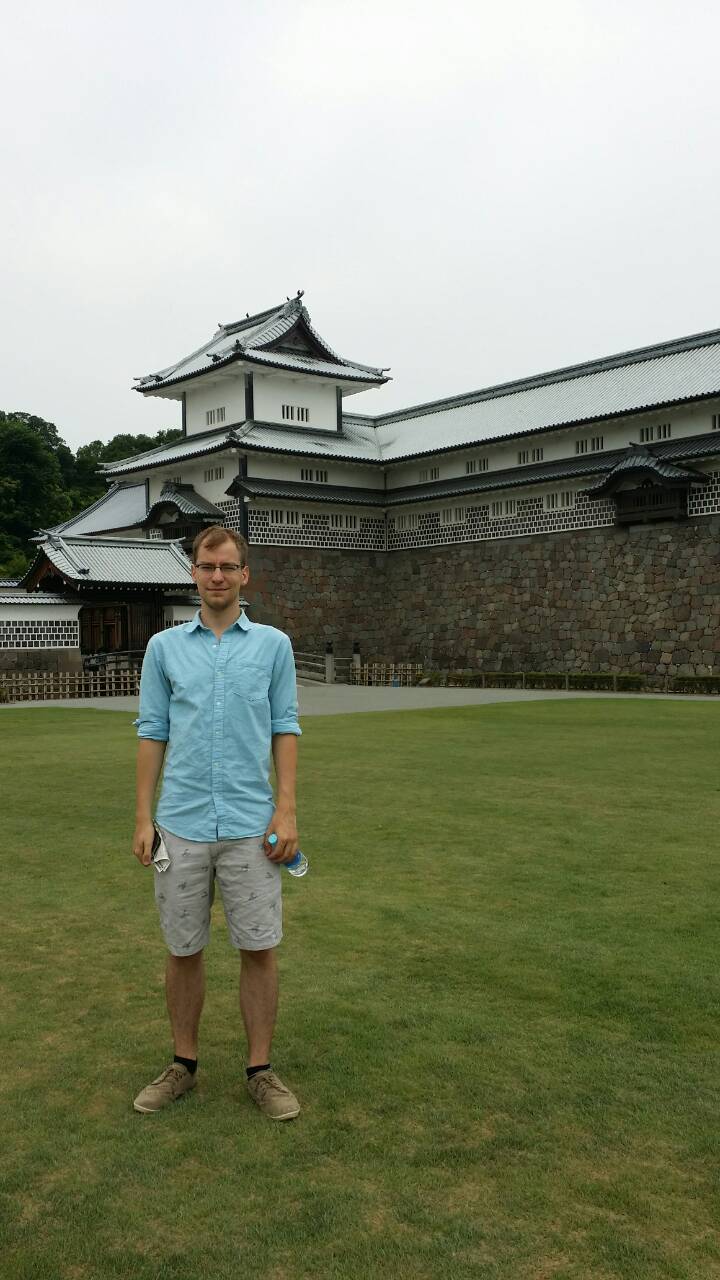
This is likely from a combination of factors. The roots of this must be my trip to Japan; that was the place where it all came from. I went to Japan and fretted continually over the fact that I may one day forget the bulk of what I experienced there.

Eventually, these feelings evaporated, but at a steep price: because they had disappeared, I was no longer inclined to record in my diary, thus making my worry a reality. The result was a thin, tattered notebook with a Magritte[2] on the cover, which contained perhaps ten pages of handwritten material for a 5-week trip. And yet, in spite of this, when I went back to read those pages, even in such a small body of text there were morsels lodged there that I never would have remembered on my own.

I’d already read my Benjamin[3] on Proust[4], though, and so the fact that a sizeable chunk of my experience would be burned up in the act of consciousness was not news to me. Though of course, even if I had not known this, Japan would have taught me that on its own.

Though the idea is represented in Benjamin[5] and Proust, the idea of consciousness-as-incineration comes from Freud[6]. He was speaking of WWI soldiers burning away the intolerable horrors and boredom they had known in the trenches.[7] I certainly don’t know anything about the horrors of trench warfare, but I do know about feelings so acute that the conscious mind burns them upon entry. This numbing usually feels like an emergency break, a kind of last-resort red button encased in glass with a little hammer next to it. But the operation can be applied to less acute or concrete situations, as well.

One such instance was Japan. The feeling being burned away: alienation.

In America, the sense of alienation is real and acute, but it never reaches that critical mass, that critical density that enables it to act as fuel. Instead, it is like moisture from rain on the logs. The logs will still burn, but dampened.

In Japan, however, the logs are damp with kerosene, not water. The sense of alienation is so hulking that it fails to fit through the door of your sensorium. It is too big. You cannot process it, so you don’t even bother. And so you stop processing. Your self disappears. Where you fit into the big picture does not matter because you don’t fit in anywhere, and there’s no illusion like there is here.

 I got into a relationship. I started waking up earlier. I thought, maybe a real job wouldn’t be so bad. And suddenly it seemed like I was merging with the salmon stream of American society. Nonsense, of course — it was a honeymoon. I am still at my core (despite a long diversion where I believed I had no core) a lone data scrounger. Maybe I am a multicore data scrounger. That’s who I am.

In Japan, this Fata Morgana[8] never appears. You know there’s no chance, so you can embrace your outsider-dom. But I’ve gotten wildly distracted. Another thing that fuels my fear of data loss — my disorganized-ness. Files, thoughts, texts spread across Google Docs, home directories, virtual machines, shell accounts and scraps of paper. Well, not too distracted, I guess.

The point is, we lose life in its happening, and we are often left holding its threads like unearthed artifacts from a long-lost Chinese dynasty.

The other point is, the mind prunes experiences for all sorts of reasons, and as a result, the ones that make it across the experience-memory barrier are special by default, even if their selection was fairly arbitrary. In this way, the experiences that do make it through to become memories are elevated above experience itself. I know this well, and often I look forward to the memory of the experience even before the experience in question has ceased impressing itself upon my sensorium. How many times have I written these same paragraphs in different ways? Is this my version of Joe Gould’s family history? Endlessly rewritten and revised, the one hazarded component of a vaporware masterpiece?

The point actually is, LIFE IS DATA LOSS. There, there’s your mantra. (A tautology, but what other formula is so certain?)

In Japan, I learned to deal with data loss by letting it happen, realizing that it’s happening would serve the greater good of furnishing memories greater than the sum of their parts. Borges[9] and Brooker[10] dealt with it by showing how disastrous perfect memory would be. Knausgaard[11] and Proust[12] dealt with it by using the void left by data loss to create fiction and art. (Well, I suppose that’s true of all of them, really).

So Japan and Benjamin primed me to read Proust. The fact that I’ve only just drawn the connection between Japan, reading Proust soon thereafter,  and my fear of data loss is itself illustrative of the process by which experiences affect us without becoming memories — and perhaps becoming more a part of us than memories ever could. So, it’s no small wonder that after Proust, Benjamin, and Japan — oh, how could I forget Knausgaard, too, which I’d even read before Japan — that data loss was on my mind. The chain of influence unwinds madly.

When I got back, as far as Japan was concerned, I’d come to peace with it. I was happy to have forgotten myself while I was there — that was enough. I knew I could rely on the burnishing effect of Proust’s mémoire involontaire[13] from thereon out. Those memories were lodged in me, and there would always be stimuli to wriggle them loose.

Obvious ones, such as a Skype call from Ikumi[14], have achieved this in only the last few days, but so have more tangential things, like perusing Story of the Stone[15] last night while Brenda studied. The Story of the Stone is Chinese, of course, but revisiting it with bits and shards and tufts of Japan in me caused the pleasure of my first reading of Cao Xueqin[16] and the lucent quality of Japan’s mémoire involontaire to overlap.

But also like Story of the Stone and Proust (my two desert island books, for sure — I need no others, really), I was possessed with a need to turn memory into art. Like Proust, this desire was driven by nothing more than a love of literature. Nothing within me was begging to be told; I wanted to write because I like to read. (As for Cao Xueqin, he never comes out and says that he wrote because he wanted to write and nothing more, but the first and especially the second two books are little else than books about books.)

My love for books is more like Xueqin, the verse collector, than Proust, the enraptured-hand-in-a-stream type.

Sure, when I first read David Foster Wallace[17], I wanted his opinion on each and everything I ran across, just like Marcel did of the Anatole France avatar in Recherche. But largely, my love of reading is a love of hyperlinking. I love Xueqin because nothing happens except literature and words, really — especially in the second volume, my favorite so far — and because the allusive nature of letters in China means Hong Lou Meng[18] is basically a repository of hyperlinks to other works.

It’s why I love collected letters, too. A beautifully written database you can live in. It’s quite video-gamish. Reading them reminds me of the way I just kind of wanted to hang out in Midgar[19] when I played Final Fantasy VII as a kid. Or Persona 2[20] more recently. The gameplay was fairly dull, but the sounds, the graphics with their smudged hardware fingerprints all over them, well, I wanted nothing more than to climb inside. The same with the scenes and landscapes described in Hong Lou Meng.

We can trace these fibers to the place they intersect: the internet. Memory, data loss, texts as hyperlinks.

Surprisingly, it took me a very long time to zero in on the internet (again, these things fold into the self and become invisible). This was probably because its influence on me was so enormous that I swung the other way in equal measure and was equally repulsed by it. Like hates like, as like recognizes like; I lived with no personal computer and no phone for months.

Interestingly, what I perceived to be my love of literature actually brought me around again to the internet. I wanted to write because I loved to read, so I began writing. I tried to write pen and paper, and I tried to keep .txt files because of their lightweight, but the former would destroy my wrists raised on keyboards and the latter would end up getting erased because I would never save them. So, I opted for the decentralized cloud method.

There are probably better options than Google Docs for the kind of scribbling I was doing, but I wanted serious stuff and scribbly stuff (and all my documents, really) in the same place because I knew the strain spreading my docs across several platforms would pose to my organizational abilities. Of course, that ended up backfiring. All that happened was I ended up keeping too much stuff in one great big pile. Google Docs ended up being too browser intensive (it’s basically an Office virtual machine inside your browser, so that’s not terribly surprising.)

Little did I know that this sporadic web of documents was jacking the sinewy chasm of my internet mind back open. I used Gutenberg[21] to chase down quotes instead of copying them by hand. I had a general file, which was my longest surviving .txt-based foray, which moved online and was quickly displaced by a document containing a list of links (I like this option over the bookmarks bar because I can make commentary). Separate docs for fiction forays, scribble pads, poetry forays, links, unorganized quotes, a full-on journal, thoughts about the internet, everything.

And that’s when I realized that the internet had given me my love for reading: I was building a massive database. And I interact with literature as though it were one great big database of interlinked works. Everything was flat and equal; the goal was to have an optimal unbroken path of digging.

And this, I have come to: ”In Proust’s calculus, Swann’s error is not so much the failure to love Odette for herself, but rather directing at a living person the human largeness of feeling and imagination that can only find compensation in art.”[22] 


[1] Annotated with infinite love and heartbreak by his mother, Elaine Gantz Wright

[2] Time Transfixed by Rene Magritte, https://www.sartle.com/artwork/time-transfixed-rene-magritte

[3] The Philosopher Stoned: What Drugs Taught Walter Benjamin, Adam Kirsch, https://www.newyorker.com/magazine/2006/08/21/the-philosopher-stoned

[4] Remembrance of Things Past, Marcel Proust, https://campuspress.yale.edu/modernismlab/remembrance-of-things-past-a-la-recherche-du-temps-perdu/

[5] The Life and Influence of Walter Benjamin, Rhys Tranter, https://rhystranter.com/2015/04/14/the-life-and-influence-of-walter-benjamin/

[6] The Pre-conscious, Conscious, and Unconscious Minds, Kendra Cherry, https://www.verywellmind.com/the-conscious-and-unconscious-mind-2795946

[7] A New Kind of Dream: Freud, Trauma and WWI: A Look at War and Artistic Creation through the Theories of Cathy Caruth and Sigmund Freud,  https://www.worldwar1centennial.org/index.php/articles-posts/4636-a-new-kind-of-dream-freud-trauma-and-wwi.html

[8] Fata Morgana: The Strange Mirages at Sea, https://www.farmersalmanac.com/fata-morgana-mirage-28630

[9] Borges and Memory: Encounters with the Human Brain, Rodrigo Quian Quiroga,  https://mitpress.mit.edu/books/borges-and-memory

[10] Algorithmic Intimacy, Prosthetic Memory and Gamification in Black Mirror, Jin Kim, https://blogs.strose.edu/wp-content/uploads/2021/08/Kim-2021-Algorithmic-Intimacy-Prosthetic-Memory-and-Gamification-in-Black-Mirror.pdf

[11] How Writing ‘My Struggle’ Undid Knausgaard, Ruth Franklin, https://www.theatlantic.com/magazine/archive/2018/11/knausgaard-devours-himself/570847/

[12] The Proust Effect: The Senses as Doorways to Lost Memories, Cretien van Campen, https://oxford.universitypressscholarship.com/view/10.1093/acprof:oso/9780199685875.001.0001/acprof-9780199685875

[13] Proust ou la mémoire involontaire, Sebastian Dieguez, https://www.cerveauetpsycho.fr/sd/neurobiologie/proust-ou-la-memoire-involontaire-1592.php

[14] [Not sure about this one, but this seems plausible – doubting it’s ’the character with the same name.] https://en.wikipedia.org/wiki/Ikumi_Nakamura

[15] Story of the Stone, Cao Xuegin,  https://www.penguinrandomhouse.com/series/BVJ/story-of-the-stone

[16] Cao Xuegin  https://www.britannica.com/biography/Cao-Zhan

[17] The Unfinished: David Foster Wallace’s Struggle to Surpass “Infinite Jest,” D.T. Max, https://www.newyorker.com/magazine/2009/03/09/the-unfinished

[18] Hong Lou Meng https://www.amazon.com/Hong-Lou-Meng-Chamber-Classics/dp/1539851230

[19] Final Fantasy Wiki, Midgar, https://finalfantasy.fandom.com/wiki/Midgar

[20] Megami Tensei Wiki, Persona 2: Innocent Sin, https://megamitensei.fandom.com/wiki/Persona_2:_Innocent_Sin

[21] The Gutenberg Project: A Library of Over 60,000 Free Books  https://www.gutenberg.org/

[22] Swann’s Way, Marcel Proust https://campuspress.yale.edu/modernismlab/swanns-way/

Data Loss Found

I just completed the final, apocalyptic season of Search Party, a quirky and bitterly clever HBO Max series. This is a bit unusual, as the darkness of my current grief grotto tends to throw a shadow on anything even remotely comedic. But the offbeat wit of this sinisterly snarky romp appealed to the cynicism of my perpetual-pandemic malaise. I’m finding the early 2022 vibe very disturbing in visceral, new ways. Could be that I’m starting the fourth year on earth without my son Elliot or that the uncertainty of our world at the tipping point has become business as usual. Probably a sum of the parts, but all I know is that it’s heavy and exhausting. And writing, usually my salve, has been a challenge in this “blue period,” too.  I might need to spend some time outside of my own head.

In Search Party, Dory, the protagonist, becomes unflinchingly obsessed with locating a college acquaintance named Chantal, whom she learns has gone missing. But the fixation quickly seizes her—dominating her life and all her relationships, including an eccentric fellow named Elliott. Interestingly, Dory never knew Chantal well, but for some unknown reason, she takes full responsibility for finding her with self-righteous zeal. It’s her raison d’être.

Dory’s all-consuming quest immediately triggered me—reminding me of my own desperate need to find my Elliot—everything, that is, about the tangled circumstances of his death and the elusive essence of his life. Much to my dismay, most of my attempts have been as fruitless as they’ve been frustrating—trying to access the data in his disabled and now permanently deleted internet accounts. These efforts have hit dead ends across the board—even after enduring the lengthy and costly process of securing the requisite court documents. I felt like Dorothy in The Wizard of Oz, judiciously delivering the witch’s broom to the Google Oz and the Amazon Web Services (AWS) gods—with results similar to those of our scrappy Kansas gal.

And this is only one of many inconsistencies and conundrums that continue to haunt me with every inhale. What I have found is that looking for answers is a little like looking for grace. It happens in its own time—and it’s something you receive but can never ask for.

So, maybe this is not about unearthing Elliot’s digital footprints or picking up his blockchain breadcrumbs. Like the metaverse itself, this dark web of secrets seems to expand and contract exponentially with each new portal crossed and backdoor cracked. Maybe the lesson is this:  it’s time to let go of the need to know. Like Dory at the end of the series (spoiler), it’s time to just steep in the mystery for a while, breathe . . . and let acceptance bloom.

Maybe it’s time to decide to just keep going and cherish the parts of Elliot that I already know: the infinite love that exists in every molecule of my being that gave him life almost thirty years ago. These are pieces I will find only inside my heart and in the hearts of those who loved him. (I think every story must be The Wizard of Oz in one way or another.)

Until . . .

You find an errant thumb drive in an old box of items you had tucked away in storage after cleaning out your deceased son’s apartment in a fog of tears three years prior. Alas, you simply can’t resist the call of the wild USB. Gingerly, you insert it in your laptop and open up the file directory as your heart beats with expectation, and you notice that much of it looks like lines of actual code, Elliot’s native language but one you do not comprehend. There are lines and lines and lines of machine-like text, strings of strange characters and backslashes, sprinkled with words like directory and subroutine. Trying to decipher it gives you a headache—as you focus intensely on each line of cryptic verbiage, hoping to uncover some hidden gem or morsel that will reveal all. You feel a little like James Bond, but the cruel reality is that without your Elliot, your “IT Help Deck,” you are still lost.

But then, you open the very last file in the list, and it’s a readable file. It’s English, and its curiously ironic title is: “Data Loss.” (Stay tuned.)

It’s All Grief to Me: 5 Things Grievers Would Like to Hear

Thankfully, I have found several groups for bereaved parents on Facebook. Yes, they are the yin to Facebook’s otherwise troubling yang, but the shattered hearts convened in them are full and present. They weave together the bitter and sweet, the dark and the light, the loss and the love. Thinking of Leonard Cohen’s wisdom, “There’s a crack in everything. That’s how the light gets in.”

These sacred conclaves provide safety and warmth in the midst of grief’s pervasive miasma. They have exacting parameters, like “Loss of an Adult Children,” “Sudden Death,” “Parents Who Have Lost Sons,” and “Refuge in Grief.” And their openheartedness is as transformative as it is devastating. In fact, their kind words often keep me functioning on my worst days. It’s a level of knowing no one else possesses. 

Part of the pain of living with the death of a child is the ancillary awkwardness of engaging with other people in the world every day. The tragic reality of losing a child is a stark identity that seeps into every interaction, whether expressed on the outside or fiercely contained on the inside. Every conversation is a reminder, ladened with trenchant decisions about what to say, how to say it or whether to say it at all. It’s like having two or three people arguing inside your head all the time.

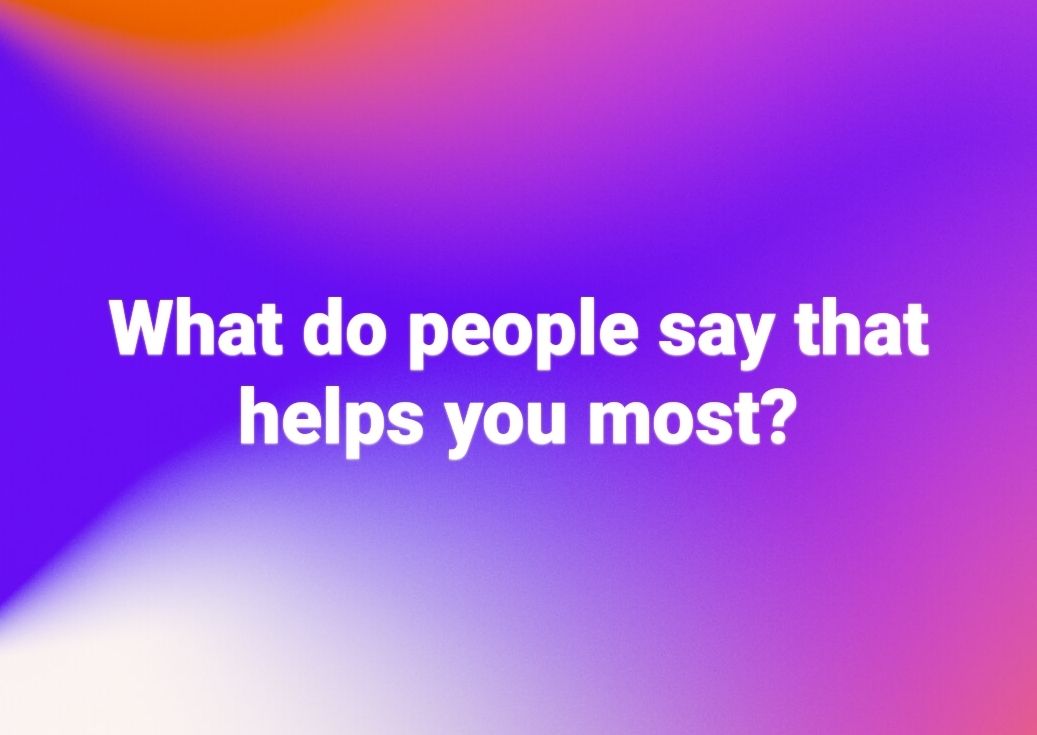
A recent question on one of these precious groups sparked a deeper dive into my own lexicon of grief. A member posted, “What do people say that helps you most?” This intrigued me, as I thought taking inventory of what resonates with this group of irreparable hearts might help other humans who stumble around those struggling with grief or who avoid them completely.

Let’s start at the top. This list is full of contractions, but then, so is grief.

  1. Nothing

Say nothing. This might seem counterintuitive, but it makes perfect sense. This is about just being present, just saying you are present. That’s all. In pre-COVID times, it meant hugging, sitting next to you on the couch or just holding a hand silently. I think this is the ultimate comfort in grief—like sitting shiva in Judaism. You don’t have to talk or offer beverages or speak. Just be. Allow the pain without fixing, evangelizing, entertaining, cajoling or minimizing. Human presence is a divine gift and a relief. In writing, it translates as “I have no words, but I am here.” Or “my heart is with you.” The grace is in the spaces between.

2. “I am here.”

“I am here” gives a voice to the above. This response ranked high. As grief guru David Kessler says, “Grief must be witnessed to be healed.” Strange but true. “I am here.” “I see you.” “I hear you.” “I am here for you.” “I am here anytime, day or night.” “I am here when you need to talk or when you don’t want to talk.” This is the power of presence.

3. Say their names, share their memories

Casual acquaintances frequently shy away from saying my son Elliot’s name, and they sometimes visibly cringe if I do. But I love it when someone asks, “Will you share a favorite memory of Elliot?” Or says, “Let’s talk about Elliot. Remember when he  . . .” or “I want to tell you a story you might not about Elliot.” Saying their names keeps their memories alive—so personally and poignantly. The invitation to share a memory somehow propels his memory into the present moment instantly. He doesn’t feel so gone. For a brief  moment, it’s more sweet than bitter.

4. “I will never comprehend your pain.”

Every grief is different—as unique as every loss. Though we may share commonalities in our stories, the essential pain is our own. Offering acknowledgement of this can be very comforting and healing—like a specially compounded ointment. “I can’t possibly begin to know your pain or how you go on.” “I have no idea what you are going through, but I am here for you in any way I can be.” I suppose this is a riff on “I am here,” adding the shared dimension of incredulity.

5. Speak from your heart

You don’t have to fix. Just feel. “My heart breaks.” “My heart hurts.” “My heart bleeds.”  “My heart is next to yours.” “My heart is with you.” There is something visceral and intimate about these statements. It’s both physical and emotional. Elliot will always live in my heart and in the hearts of all those who adored him—the agony and the joy in one place.

I am in no way suggesting we should script such things. Far from it, but I would like to see us cultivate a greater ease and openness with loss—allowing space for its enormity to expand. It is scary, but we are here on the earth to be in relationship—to be better at being human in the hard times.

But as a grief-averse culture, we simply don’t have the everyday language around life’s most painful events. I find this ironic since the pandemic has made the immediacy of grief as much a part of life as the joy of birth. And yet, the social dialogue is still tense, brittle and detached. So much so, we continue to default to the perfunctory, “I’m so sorry for your loss.” How did this happen? I’m sorry . . . for your loss? It does not even make sense. You don’t need to apologize for my loss. And “sorry” is a flimsy word, like trying to put out a fire with a Dixie cup. Just feels inadequate.

In the ebb and flow of the pandemic, we are in a both/and world—forced to learn a new way to be as we live. There is no new normal. Perhaps, a new tolerable—with the occasional glimmer of joy. I want to learn to carry the loss and the love together, the grief and the grace. Grief will always be a part of who I am down to the marrow—not just something that happened to me I have to get over. The tap dance of OK-ness is utterly exhausting. But the dark pit of despair is no place to exist, either.

So, I’m not going to list the ridiculous clichés. You’ve heard them. You may even say them. (No judgement.) But here are a few other great words worth sharing from the collection:

This totally sucks, but I’ve got you.”

“I want to know everything about Elliot—when you are ready.”

“You will get to a place where the sting of the pain softens a bit. Until then, I will be here for you every step of the way.”

“I love you. You are loved . . . always.”

“It’s OK to not be OK for as long as it takes. Allow yourself to feel and grieve at your own pace.”

“If you want to share your pain, I will catch what I can. I am here to sit or listen, and hold a space for you.”

“I can’t take your pain away, but I do have a shoulder to cry on and ears to listen.”

Megan Devine, another one of my grief gurus says, “Acknowledgement makes things better even when they cannot be made right. It’s a radical act to allow others pain and sit beside them with it.” In the end, grief is love.

Over the Rainbow: On the Edge of August

Maybe it’s the accumulation of almost sixty years of living in this body, but I am feeling the weight of my existence. No, my survival. I feel like I have been in survival mode—consciously or unconsciously for nearly half my life. That takes my breath away. Yet the past three years have eclipsed everything that came before. The loss of my son Elliot three years ago on August 5, 2018, at age 26 is the heaviest of all.

With August just days away, I have been drilling down into my search for a sense of renewed purpose in my life. With my son Ian in the interactive thick of his gaming master’s program at SMU, I have been peeling back the layers of my personal onion lately—asking myself all those daunting and stupefying questions:  How do I find meaning?  Why am I  here? What’s next?  How did I get here? Where do I belong? What should I do? All the usual cocktail party banter. Oh, how festive a good cocktail party used to be . . .

Writing helps. But it can be both an astringent and a salve—like pouring hydrogen peroxide on a wound to make it sizzle with pain, then soothing it with a healing ointment. This is an inescapable reality of living in the ubiquity of grief—a curse and a blessing, pain and gratitude, light and dark—all about finding a way to carry both with grace and aplomb. Ah, but there’s the rub. I seem to be fresh out of aplomb, but that might not be such a terrible thing. Stripping off the hardened layers of figurative varnish, liberally applied over the years to make everything look good on the outside, is probably healthy. Authenticity is definitely less work but more vulnerable. I have found that being present, grounded and real in the moment has its advantages.

Feeling bravely. Letting go. Saying no. Intentionally noticing where I am—to calm my unconsciously triggered nervous system. That’s the work. I can try to override an event intellectually, but my body keeps the score and always wins (referencing a seminal book on the subject by Bessel van der Kolk.) That’s pretty much how I roll now. Simple? Not always.

Process. Trust the  process. But trust the process?

As another August looms, it’s getting harder to breathe, especially since I am about to mark six decades on the planet on the 15th.  I also am remembering my late Aunt Virginia, who would have been 98 on August 6, and my mother, who died on August 22, 2012. Her birthday is August 27, and she would have been 86-ish. I’m a little vague on this, because my mom fudged her date of birth for so many years that she could never authoritatively confirm it. Regardless, August is heavy, and nine years later, my heart breaks for my mother—charming and magnanimous in public, but resentful and insecure in private. And tragically, her devastating stroke snatched her flamboyant life away far too soon—after leaving her paralyzed, brain-damaged and bedridden for nearly two years.

Thinking of Elliot and my mother on the edge of August, I am wondering about the journey of souls and the nature of life. Are Elliot, Mother, Father, Aunt Virginia, Cousin Scott, and my beloved mentor Ann Abbe together in some parallel cosmic dimension watching me try to function? Sometimes, I think so, but I’m not sure. When I interacted with my mother, aphasic after her stroke, she could say only “bah-bah-bah” with no discernible meaning attached. Yes, she was awake and present, but she was not there in a way I recognized. I suppose the mask of her larger-than-life self had dissolved. Being with her toward the end, I learned that souls have nothing to do with speech, thoughts or cognitive function. Her body was a mere vessel, still containing her spirit, but the violent rewiring of her brain’s circuits caused by the vicious stroke had amplified the serenity of her core essence somehow. It’s a strange thing to say, I know, but she seemed blissful, even giddy with childlike innocence. I was grateful for that part and wondered: Was this a glimpse of eternity?

When I was a little girl with my eyes open wide in the middle of the night under the covers, I tried desperately to visualize what heaven would be like. Would God be there? Would we frolic with angels amongst the clouds eating chocolate cake and picking flowers?  Would the streets be paved with gold and diamonds? What exactly was heaven, anyway?

I am still wondering about souls.

While the human being consists of physical matter, the soul is quite literally a piece of God, the Divine. The teachings of the Quran tell us the soul of each individual person is located in the eighth chakra at the top of the head, above the crown chakra. The power is not visible to human eyes, but it’s like the flow of electric current. And New Agers conjecture, “Your soul is your conscience, energy with no form or location that is part of the whole universe. The meaning of life is to evolve your conscience to higher consciousness—the source of all existence.”

Hard to pin down. Even harder to find.

Since Elliot died, I have never reached a point of feeling better— just different, and sometimes surprisingly so. His absence is always present. It never goes away, but maybe I’m learning to accept it—little by little, moment by moment. Not how it could have happened, but the reality that it did. I cherish the moments of forgiveness—for Elliot and for myself.  And then, a wave of grief hijacks me again. Alas, sustainable peace is just beyond my grasp right now, like the elusiveness of a distant rainbow I saw engulfing the morning sky yesterday. For a brief instant, I thought it might be Elliot—gorgeous in its subtle palette but ephemeral in its existence.

Then, I noticed something I never had—the bitter sweetness of a rainbow. Yes, there is beauty in its vivid hues, but it’s contained in a grand arch of sorrow enveloping the sky, the earth in mourning for my Elliot. I stopped in my tracks and wondered if I were the only one transfixed in this moment of poignant beauty. For so many, the rainbow is the ultimate symbol of hope and happiness, the stunning surprise belying the sadness of its form. But this is the way I meet every day and every moment of my life—such an apt metaphor for living with the untimely loss of my flesh and blood, my baby Elliot. The only solace it that he will always be in my heart—and alive in the hearts of so many who adored him.

.

Remembering Aunt Virginia and Terms of Debridement

My fearless Aunt Virginia Thompson died at age 96 on this day in June 2020 from a withering body and what I suspect were lingering complications of undiagnosed COVID she contracted in December 2019 before testing was available. I learned much from our time together in her final years on this earth, including the intensity of her faith and the ferocity of her resolve.

            In May/June of 2018, I accompanied Virginia on her weekly visits to the  Presbyterian Hospital Dallas Wound Clinic. She was treating a stubbornly angry wound she had suffered from somehow hitting the outside of her right ankle on the inside of her wheelchair wheel. It refused to heal. The folks at Presbyterian Village North, her assisted living home, had run out of options. 

            At that time, little did I know that in a matter of weeks, August 5, 2018, my mercurial first-born son, Elliot Everett Wright, would soar off his motorcycle, over the inadequate barrier on the elevated LBJ TEXpress entrance ramp and into the arms of the angels. Little did I know that this extraordinary human would take his last shallow breath on an otherwise-normal Sunday, at the very same hospital and place where he took his first breath on a Sunday, just 26 years prior. The strange confluence of these significant events still takes my breath away.

            Grief is an obtuse companion—how it ebbs and flows but also is always present. Some days, it takes effort to breathe, and others, I am able to skim along on the surface of things. But I have been thinking about the weeks leading up to the day Elliot died, after which nothing has been the same—the encounters that were, perhaps, preparing me through some strange cosmic stratagem to carry the unbearable one day. On these biweekly visits with Virginia to the wound clinic, I definitely learned something powerful about grief and the importance of pain.

            On our first visit to this chaotic clinic, I was struck by the sheer volume of patients, all seeking some sort of pain relief. There were not enough chairs for everyone. I stood. There were babies, teenagers, grandfathers, society matrons and athletes. Pain is the great leveler. I saw one disturbingly gaunt man slouched in his wheelchair with his bandaged ankle plopped in the lap of a young man with a green mohawk and an illegible tattoo on his exposed upper arm. He might have been his son. The man spoke with a gusto that filled the room. I think he must have been a teacher.

            “I believe in word economy,” he proclaimed. “I read that boy’s paper, and he used commas like he keeps them in a saltshaker.” I chuckled, but no one else in the room reacted.

            “Ms. Thompson!” the out-of-breath nurse shouted as she cracked the door.

            That was Virginia’s married name. More accurately, her “formerly married” name—the fragile identity she’d maintained for more than fifty years after Don left. I grabbed the handles on the wheelchair she usually propels with her own two feet, and we were off down the hall, meeting Dr. Moran at the door.

            “How are you doing?” asked the chestnut-maned doc as she ushered us in.

            “Just fine,” Virginia quipped.

            “This is not uncommon,” said Dr. Moran, “but it’s a bear to heal. It’s a problem of pressure. I’ll bet you sleep on your right side, don’t you? We must offload the pressure. That’s all there is to it.”

            “Offload.” Ah, there’s a lesson, I thought.

            “This is gonna hurt . . . a lot,” she warned as her nurse squirted the swollen, red ankle with lidocaine.

            “This is what we call debridement,” Dr. Moran explained. “We have to remind the body how to heal. We need to remove the dead skin that gets in the way. This sends the body’s healing properties and enzymes to the wound to liquefy the rancid eschar and slough. ”

            Virginia winced and closed her eyes tightly, but I could tell she wanted to show Dr. Moran she could take it, whatever she dished out. Then, I saw one glistening droplet run down her wrinkled cheek.

            “Are you OK?” I asked quietly. I have never seen her register pain, and she has endured much in her life. She nodded.

            “I know that hurt . . .  Uh, Ginny, more lidocaine here,” said Dr. Moran. “We need to rally all the resources we can to heal this bugger.”

            Virginia took a breath as the kind and efficient tech wrapped her puffy leg with focused precision. Moran gave us a list of instructions and pointed us to our next stop—radiology in the main hospital for an x-ray.

            I am grateful for these times with my venerable aunt. She shared so much about her life and so many of my family’s deeply hidden wounds. And this memory reminds me that sometimes the healing process requires a seismic jolt, or two or three—like removing the dead tissue multiple times, if necessary. We can’t let unattended wounds just scab over and pretend like everything is OK while the tissue underneath continues to fester in dank darkness. Ignoring pain does not relieve it. And it takes as long as it takes.

            Yet the loss of a child is a wound that will never heal completely. The tenacious scar tissue in my heart will always be there, but maybe, eventually, I can find a new way to live with the bittersweetness of the disfigurement. And maybe, talking (or writing) about my losses can help me get to that place—kind of like debridement of the spirit. It’s French – from débrider, to remove adhesions or to literally unbridle. Grief must be witnessed to help lift the weight of its bridle. Grief needs air to heal. 

            People may think talking about Elliot, Aunt Virginia, her son, or even my parents will upset me, but that’s exacting what I need. It triggers the pain, but the tears are the tonic. The pain never goes away, anyway. Not ever. But pain does play a role— signaling that something is horribly wrong, rallying the body’s resources—calling in the Navy Seals of the heart. Though the body possesses miraculous organic self-healing capabilities, sometimes the process hits a snag. It stymies, and it needs a little help to progress.

            With grief, we must do just that—debride it, as many times as required. Don’t cover it up with a bandage or pretend you are OK. We are not OK, because the pain of our grief is our barometer of love. That never dies. As complicated as our relationships might have been in life, we never stop loving—particularly those lives we brought into this world. We must revisit the pain that makes us physically wince to move through it. It’s a necessary cringe—with the caveat: Don’t build a condo there.

            We don’t always know why healing pauses, but we do know why pain exists—to tell us something is terribly wrong. Pain is a potent teacher. But senescence can happen to wounds. Senescent comes from the Latin senēscere, “to grow old.” In medicine or biology, it refers to cells that are still metabolically alive— but are no longer capable of dividing. Dormant.  Merely existing, not thriving. That’s why they need attention. Or else the virulence of unattended wounds will manifest somewhere else.

            Therefore, we must tell and retell our stories—that is our task as humans. That is why we are here on the planet. Finding situations and people who will listen and support us unconditionally is essential—people who give us the space to remember our losses and foreshadow what they mean for our futures. These people are rare and cherished. Without their divine grace, we will never completely emerge from this suffocating miasma (one of Elliot’s favorite words). In fact, a friend/mentor in my grief support community says that to endure grief, we need two things: faith and community. Together, they help us expand our worlds beyond the loss and give our festering wounds the room to debride.

            Having lost Aunt Virginia, Elliot, and almost all of my family members over the past decade, my experience of grief is constantly conflating, deepening, expanding and shifting—but it is always there. Still, grief is what makes us all excruciatingly human. Let’s fiercely embrace the pain—and each other.

            Godspeed, Aunt Virginia.

Rabbit Rabbit

I saw another rabbit blur
across my path today.
“Say rabbit, rabbit”
on the first day of the month—
for luck

For today,
tomorrow and
yesterday, still
braided in
conflating ache.

I saw a rabbit.
in a lush garden—
on a blustery day
of grace, all about grief
stricken souls
longing to fill chasms
of anxious loss.

Pain and peace together,
as one, contained
in this quiet space—
sacred, witnessed
healing.

But where are you going?
Where are you now?
Is that you . . . a sign?
So urgent and quick.
Darting—
across the graveled grass
playground, where
your brother once ran.

I follow but cannot catch you.
I tiptoe but cannot touch you.
I reach out but cannot hold you
in this life,
“late for a very important date”
in your quixotic Wonderland.

Detached but curious,
Elusive but Spirited
Away—forever
Hiding in the shrubs.

Leaving me,
heart-heavy,
heart-sick,
heart-full.

May your mischief
with my mourning
mix
in memories,
and mysteries,
everlasting
love