It’s an inside job

lemons“You must have chaos within you to give birth to a dancing star.”
— Friedrich Nietzsche

Often, the universe dishes up not just one or two pesky, little hurdles – but a veritable tsunami of desolation. The real challenge is  processing it all productively and assessing our authentic truth — not anyone else’s version, mind you, but our very own.  In the aftermath, we do some serious onion peeling — but that’s easier said than done. Life is messy.

I believe these times of vertigo-inducing, tummy-tickling turmoil consume us for a reason — to shake us up and down, over and around — to help us see a new perspective and another side. The trick is identifying the nuggets of wisdom in the swirling vortex and harnessing their positive power to make us stronger, clearer, and wiser — like making lemons into lemonade. (Or sautéing those onion layers into a scrumptious caramelized concoction.) These analogies may seem a little hackneyed, but the truth is that I seem to have harvested a bumper crop of lemons lately — in love, work, family, etc. Sweet turned to sour and fresh to foul.

I read somewhere that this is all a simple law of physics — or metaphysics, as the case may be. “It’s like patterned disorder,” says life coach Martha Beck. “And in nature, it creates beautiful things.” She contends that instead of being tortured, perhaps we are being steered—“dressed as chaos.” It’s all about reversing our assumptions.  Love that!

“Little miracles begin happening to you whenever you turn toward your right life,” says Beck — even if it’s in the middle of the muck and mire. Small miracles turn into big ones. And she’s oh, so correct. The tiny miracles ARE all around me— if I just pay attention.

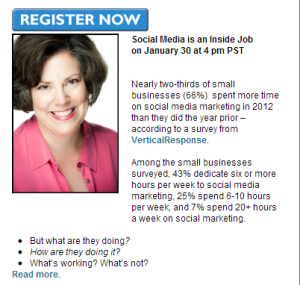
In fact, here’s one—looking forward to delivering a webinar on Jan. 30, 2013, for NALA, the National Association of Local Advertisers and Jeff Velis, vice president of operations and esteemed former colleague.  It’s called Social Media is an Inside Job. Thank you, Jeff.  Can’t wait!

UntitledWhat are your questions about building a crackerjack content strategy for your business or enterprise? Join us!

And let the new journey begin!

2012 in review

Thank you, gentle readers! Was a busy year in the “life” department. Hang on tight for 2013.

The WordPress.com stats helper monkeys prepared a 2012 annual report for this blog.

Here’s an excerpt:

600 people reached the top of Mt. Everest in 2012. This blog got about 1,900 views in 2012. If every person who reached the top of Mt. Everest viewed this blog, it would have taken 3 years to get that many views.

Click here to see the complete report.

Penetrating Thin Places

“Pain that we cannot forget falls drop by drop upon the heart and in our own despair, against our will, comes wisdom through the awful grace of God.”

– Aeschylus

I’m writing about something different today.  Since my mother’s death, I’ve been thinking about thin places.

“Where Heaven and Earth Come Closer” was the headline of a New York Times article from earlier this year.  The writer highlighted divinely infused places near and far–but added that they need not always be sacred in nature.  One might find an airport, a bar, or your front porch at sunset just as soul inspiring as the Blue Mosque in Istanbul or St. Peter’s Basilica in Vatican City.

In fact, he held that such significant places may even contain “the confluence of the sacred and the profane”—such as Jerusalem, for instance, combining the timeless profundity of the divine with the historical weight of unending conflict.  And Weiner added, “Getting to a thin place usually requires a bit of sweat. One does not typically hop in a taxi to a thin place, but sometimes you can.”

While I agree with the sweat-equity notion, the actual voyage required can vary significantly—depending on the measure of time, physical distance, heart, mind or soul required.  I have written about the phenomenon of locations as thin places in the past – Mo Ranch and Montreat, the locales that Presbyterians revere so passionately.  Mo Ranch is nestled deep in the heart of the Texas Hill Country on the Guadalupe river and requires  many, many hours in a car (a particularly lengthy trip when traveled with a rambunctious collection of adolescent boys.) And Montreat is cradled in the lush, majestic Black mountains in North Carolina’s remotest wilderness.

Yet in recent months, the thin places I have experienced have been characterized less by place and more by spirit. Curiously, they have been almost ubiquitous—those mystical portals to the realm of the soul—where the gossamer veil that separates us from our Source feels more permeable somehow.

These are places where God’s presence is palpable.

I believe I have been encountering this phenomenon with increased frequency—not because there are more around me—but because I have been graced with their recognition as a means of comfort through an extraordinarily difficult time in my life.

The priest who officiated at my mother’s memorial service in August referenced “a thin place” as he endeavored to placate my family in the poignant moments prior to stepping into the St. Michael’s and All Angels Chapel, where my mother’s public waited.  Father Kevin Huddleston framed it in almost Spielberg-esque  terms—as if we might notice the stained glass windows behind the altar dissolving into a hazy image of heaven—thus providing a glimpse of my mother’s welcome release from pain and earthly struggle as she crossed to the other side.

I deeply appreciate the concept of thin places, but ironically, they have a cumulative weight.

But now I know—the thinnest places of all are not on a hill, in a river, or in church building. They are not behind a stained glass window or on a beach. Don’t get me wrong. These can be small pockets of heaven—true glimpses of the divine creation. But, I now know the thinnest places we can know are in the heart.

Somehow, for most of my 50+ years, I lacked the heart connection I so yearned for with my mother and father. There are many reasons and circumstances around this reality, but they are in the past. This makes the bittersweet gift I received during the last few weeks of my mother’s life even more precious and meaningful.  I literally felt the hand of God in our interactions. Undeniable and visceral. Though her stroke completely destroyed the brain cells responsible for her speech, cognition and movement, she was able to make noises, cast her gaze and react—caught in a physical prison offering few options for more than two and a half years. In the moment with my mom, her state was simultaneously devastating and sublime to witness—truly the confluence of the sacred and profane.

It was pure, raw, authentic spirit– unfettered by any conscious understanding of her paralyzed confinement in a wheelchair. Her essence seemed to transcend her circumstances—the angry bed sores, deep purple bruises and expanding edema that rendered her atrophied limbs almost unrecognizable. Even with the misfiring synapses and unpredictable responses, her heart and soul were discernible.  She could not be squelched or muted. Her life force burst out through her eyes and enlivened her playful, coquettish smile. She reached out to me in a way she never had—expressing volumes in a simple squeeze of her hand.

Swollen, paralyzed, aphasic, and racked with by infection in those final days, my mom was unable to comprehend the world around her in conventional ways. But I was certain I was seeing her soul. My eyes would well with tears as I acknowledged the holy privilege of witnessing my her pure spirit – her unvarnished, unadorned, raw being – her Divinity.

What is this heart connection—this exquisite vulnerability that defies description? It is the unique imperative of our being, and yet, it eludes so many of us in our lives. Who are we – beneath the words, languages, thoughts, and unconscious programming? Who are we behind the artifice of the person we think we are, the person we feel we need to be or the person who we want to be? So often, we seem to allow our fears and the perceptions of  others define us—obscuring who we are at the very core. What a remarkable sight to have seen.

It’s nothing short of a miracle – this very thinnest of places, this glimpse of eternity.

For Facebook, is it really about time?

They say it’s about time—that’s Timeline, the new Facebook interface. But at the end of the day or week or month, I suspect it’s also very much about money.

I have been encountering many questions about what Facebook’s newest alchemy means to marketing and business—but somehow, we are all sticking with it and muddling through. The impact on our brands, businesses and personal communications remains to be fully assessed, but in the meantime, a little Facebook insight can help you navigate the sometimes murky online waters. As Mark Zuckerberg’s latest strategic offensive – particularly addressing Google+, this metamorphosis may have you more than a little perplexed, befuddled or even impatient with the ubiquitous Facebook phenomenon. That’s OK. Still, 50 percent of the more than 800 million registered users visit daily for an average of 14 minutes. That’s ample time to get in line.

In so many ways, Facebook is still the Internet juggernaut—even as sites such as Pinterest seem to be gaining momentum on the starboard bow. One of my sassiest Facebook pals posted recently, “If Pinterest is wrong, I don’t want to be right.” Interestingly, Pinterest is definitely doing something right—carving out a new niche or paradigm that is more about following content and less about “connecting” with people. Hey, let’s hear it for content! And with Facebook’s recent purchase of Instagram for $1 billion, Zuckerberg is definitely becoming much more image conscious.

Nevertheless, the latest series of changes signals that Facebook is about people sharing with their friends—not as much about brands sharing with people. Actually, Facebook is challenging brands to more effectively align with Facebook’s underlying user-experience philosophy and gestalt. As an early impresario of the “like” campaign for clients, I have mixed feelings about the latest changes that eliminate forced “like” landing pages to drive brand engagement. Intuitively, it was always a great concept, yet the reality produced questionable brand value with respect to “like” relevance, stickiness, and measurable brand ROI. And from a technical perspective, Facebook did not really make this kind of campaign an easy endeavor.

Brand pages can still offer action-focused, tabbed content–located along the middle bar. It is simply no longer an option to set it as a compulsory initial landing page to drive “likes.” As a visual junky, myself, I love the new masthead image bar. There are so many high-impact options to available for brands in that prime real estate above the fold. Just don’t include blatant contact information, such as phone numbers or arrows pointing to your flashing URL, or the “Faceboook police” may be knocking on your screen!

Back to the balance sheet–as Facebook has diminished the prominence of the “like” page and newsfeed presence, it has enhanced social advertising, pay-per-click and targeting opportunities. But, think about. Those are the money shots. Newsfeed exposure will still be important for brands–yet a harder nut to crack. We’ll have to work smarter creating engaging content and re-calibrating our publishing cadences since response currency, re-posting, and commenting will count more than the number of fans in determining message impressions and frequency. From a macro perspective, the latest changes have both expanded and refined the ways people can interact with each other on Facebook.

Here are the real tent poles:

Real-time interaction — Increased emphasis on real-time interactions with the introduction of the “Friend News Ticker,” in the upper right corner, which also integrates Twitter.

Image Focus — Larger spaces for pictures and video enhance the user experience and better prioritize the things users see in their news feeds. Plus, you can rank and filter some content, but for the most part, Facebook still decides!

List Maintenance — The new “List” feature, “borrowed” from Google+ and to some extent, Twitter, allows you to segment, tag, share and sort what specific friend categories can see on your wall. This basically pre-sorts audiences by actions and keywords. And yes, it’s all about enhancing advertising segmentation and sales. “But what about privacy?” you ask. Guess that’s another post.

Implications for Brands and Business:

1. Creativity and Activity — After one week of implementing the new Newsfeed, impressions (or reach) per post were down 33 percent in a study done by EdgeRank Checker. But likes and comments were up 17 percent, so it looks like Facebook is changing the dynamic as envisioned.

2. Frequency — Brands will likely need to alter tactics—publishing more engaging, relevant, fresher content more frequently to drive greater interactions rather than one-click passive likes/fans. If the average current fan access ratio is 10% or less, reach and impressions will take a short-term dip until we better understand and respond to changes in Facebook’s filtering algorithm.

2. Pictures and Videos Images are becoming larger on the page and much more important. If we need to get fans more engaged and spending more time, we’ll need to create and use more visuals more frequently.

3. App It — There will be more emphasis on building Apps that provide functionality and value to Facebook users to gain access to the Ticker, for instance. One idea might be loyalty points, interactive functionality, or useful tools, such as store locators to increase impressions and re-posting/sharing.

We’ll have to watch. We are already hearing rumblings that from some users that Facebook is becoming too complicated, too labor-intensive, or too intrusive. This is understandable. Many of us do not want to work that hard. We have enough to do in our lives. This won’t be the last Facebook iteration, and the impact is still unclear. However, it’s a platform you cannot ignore. The best strategy is to discover ways you can seize the opportunity.

What do you think of Timeline?

2011 in blog review

The WordPress.com stats helper monkeys prepared a 2011 annual report for this blog.

2011 was a transformation in so many ways.  And my blog “role” was one of many in transition. Thanks for  sticking around and staying tuned. Hang on tight–we are going to have a fabulous year!!! 2012, bring it on.

Warmest regards, love and light,

Elaine

Here’s an excerpt:

A San Francisco cable car holds 60 people. This blog was viewed about 2,500 times in 2011. If it were a cable car, it would take about 42 trips to carry that many people.

Click here to see the complete report.

Twitter or Facebook?

Is that one of those fundamental questions like–The Beatles or The Rolling Stones; chocolate or vanilla; Letterman or Leno; paper or plastic?

Last week, a friend of mine sent me an article published by Slate“Who I Follow on Twitter and Why.” It was kind of a light-bulb moment. We seem to lump Twitter and  Facebook into the same bucket, “You on Facebook and Twitter?” But they are really so radically different.

I love discussing this stuff, because we are right in the thick of such a pervasive transformation in communication. We have no concept how this moment in time we are living right now will impact our behavior, relationships, culture, and lives in the next few years–and for the rest of eternity.

Not that Twitter will stand the test of time or  be around in the year 2100, but who knows what communication will look like then? Getting back to the here and now, I really do think there are “Twitter people” and “Facebook people.” I deal in both professionally–and more and more, Linked In. But they all render fiercely different experiences and visitor payoffs. As I was exploring this “Twitter person” concept, I found this Venn diagram from BoingBoing. It provides another way to slice and understand social-media behavior.  I guess the increasing interest in Twitter is understandable–as sort of the nexus of it all.

I agree with erudite Shafer in Slate  that Twitter is most valuable as a resource and a research tool.  It’s like a custom real-time info stream that’s completely personalized.  Connect with the great thinkers and follow the interesting things they say. Plus, you have the added benefit of commanding much higher quality attention from Google–from an SEO perspective. Hey, I smiled when I received a notification that Yoko Ono was following me on Twitter — even if it’s “her people.”

I read somewhere that Facebook is like playing in your fenced-in backyard. Twitter is like playing in the street. You are much more exposed, yet the asynchronous format is much more impersonal. Following is actually much less social than friending. Except for the way Mark Zuckerberg can mine our clicks and our navigation paths, I don’t buy the security complaints on Facebook. A user can manage access. You can protect everything you post with your settings dashboard. My son Elliot is a very good example. His profile is so well hidden, the way can see it is when he accidentally leaves it up on his computer. LOL. That’s security, huh?

As to Shafer’s being nonplussed about receiving a friend request from someone who ostensibly does not like you, consider Winston Churchill’s recommendation, “Keep your enemies close.”

Are you a Twitter person or a Facebook person? And why? Let me know . . .

Time Traveled

Notes from a social media Cyrano.

Time. A noun. Verb. Adjective.
We don’t have time. Oh, we’ll make the time.
We spend time, save time, buy time.
Are we living on borrowed time? People give us their time. Really?
But we took the time. Will I be on time? Well, at least, we made good time.
What time is it? In real time. Oh, time’s up. Is it all a waste of time?

All in good time.
But time waits for no one. Time marches on.
What’s time does it start?

Time’s ticking away. Time flies.
Time sensitive, stamp, warp– crunch.
Is it good timing or bad?
Oh, there’ll come a time.
It’s just a matter of time. Time after time. Any time at all.
Somewhere in time. They didn’t get there in time.
Is time on our side? Is there enough time?
If you could just save time in a bottle. . .
Time isn’t holding us; time isn’t after us.
But, we’re running out of time.

Does anybody really know what time it is? Is time an illusion?That’s exactly what I hear all the time.  

Time is on my mind—can you tell? It’s front and center as I face the half-century mark in a matter of weeks, in fact. Somehow 50 years on this earth is poignant and powerful—especially since events of the past couple of years have completely taxed my resilience, heart, faith and very existence. I keep thinking there is something on the other side this personal and professional chaos— a sort of rebirth or even anagnorisis, as the protagonist might have in ancient Greek tragedy. You know that frightening feeling when you get swept away in a wave at the beach—and for those few harrowing moments in time, seemingly suspended, you have no idea which way is up, nor if you will find your way to the surface?

Age 50 would be a more than poetic time to find my way to the surface, don’t you think? Gandhi discovered at 50 his real mission in nonviolent resistance, and Cervantes was older than that when he began his career as a novelist. As Nietzsche said, “You must have chaos within you to give birth to a dancing star.”
Speaking of time, it’s been a long time since I wrote my own blog. Funny how it works—when you develop an expertise, especially a non-traditional one, you often end up doing it for someone else. I write for others now. I guess you could say I’m a ghost blogger – a sort of social media Cyrano. It’s an interesting role to play—creating the authentic voice of another—in particular a business—a bit like acting. The goal is to humanize the corporate persona in a social media stratosphere. Gotta admit that it’s a challenge managing the tightrope of “corporate transparency”—kind of an oxymoron–and the real time attention required in the brave new world of instant gratification.

In the early days of advertising, businesses traded money for exposure, and today, in the new media world, we trade money for time. Real time.  Some tasks are automated, but it’s difficult to automate authenticity.

In fact, so many of my clients say, “I just don’t have the time for this.” And they are right. It’s like living a double life—the online persona and the business pro.
But with more than 600 million Facebook users,  somebody has time!

So really, it’s not about time.
It’s about the value of the experience–and the joy. It’s about connection and the fun.  A recent poll by Priority Management, Inc. had an answer.  In a lifetime, the average American will spend:

• 6 months sitting at stoplights
• 1 year looking for misplaced objects
• 2 years unsuccessfully returning phone calls
• 7 years waiting in line

Maslow’s Hierarchy of Needs tells us that a sense of belonging is just above safety and security. And, the irony is – we can’t self- actualize alone. So, enter social media. Even if it’s electronic, it’s human connection and the ability to feel part of something. It’s a new kind of relationship reality. So, I guess time is not as important as choice.

It’s about choices we make. Personal choices. So many choices, and just where does the time go?

2011: From “Oh, Wow!” to “So, How?”

Elaine Gantz Wright is a social media coach and consultant — providing the practical tools and action plans you need to survive and thrive in the brave new media world. She is a listener, writer, blogger, speaker, actor, and mom. Contact her ellagantz@sbcglobal.net

What have you always wanted to know about social media but were afraid to ask? Register for Breakfast and Blogs, a very social session with Elaine to find out. Start off your New Year with real social media sizzle.  Thurs., Jan 13  — 9:30 a.m.– 12:00 p.m., $10 at La Madeleine Preston Forest.

I’m really not sure how many people do this sort of thing, but I am actually going back to my predictions for 2010 – to compare them to what really happened.  It was as daunting and perplexing a task as I imagined. Especially since social media evolution is anything but linear. One thing we do know it that Google Wave never quite hit the beach.

My most significant memory from last year’s missive was actually my delight when Chris Brogan actually chimed in. Wow. Now that’s what I call social media He wrote:
I like and agree with the first four. I disagree with 5. Email is still the main protocol of the Internet age. I *wish* it were different, but definitely not in 2010. Great post.”

My number #5 was: “Email as We Know it Will Become Passé.”
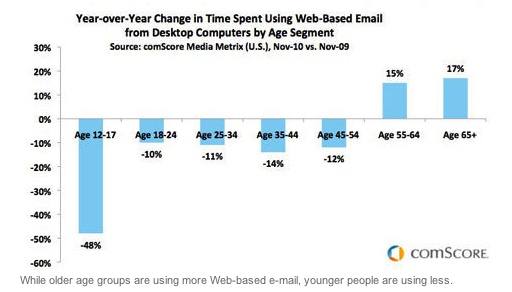
So, I guess we’ll begin with the end – #5. Well, as Chris Brogan said, email did not go away in 2010. But, I venture to add this was probably just slightly premature. With Facebook’s Messaging Hub beginning to bubble up and mobile technology/SMS infiltrating our lives in terms of behavior, I think we are looking at more of an email mutation than elimination.  When Facebook COO Sheryl Sandberg made her prediction that email is “probably going away” at the Nielsen Consumer 360, many balked, but her point about teenagers is well-taken. Stats she cited indicate that only 11% of teens email daily, and as we know, teenagers are really “the beta testers” for future techno-media trends. In fact, I have my own focus group right here in my own home. My 18-year-old would rather text than talk. He has Facebook up on his laptop whenever it’s turned on, sends very few emails and never uses the speaking function on the phone. My 14-year-old son is really text only. Good thing I have unlimited texting, or I we would be under a bridge somewhere. He never opens up email or even Facebook. Should Mark be worried? Hmm. We’ll just wait and see.

The most interesting shift between late 2009 and late 2010 is that the questions people are asking have changed dramatically. People don’t seem to be asking, “Hey, what’s the next big thing?” “What’s the next Twitter?” It’s more about implementation and impact – “What’s the most effective platform for my business?” “How do I integrate this into my daily operations?” “Where’s the best ROI?”  It’s no longer “oh wow!” It’s “so, how?” Social media tools and behaviors are now a given, our modus operandi. We just need to figure out how to do it. The old advertising model of trading money for attention is the anachronism. The new formula is trading time (even  energy) for attention. The activity is just as important as the message.

“Social Media Will Become Less Social.”hmm
I’d still like my term – “return on engagement.” It’s more active, deliberate and participatory. However, I think our trajectory has been very different from what I expected — largely due to the meteoric growth of Facebook. Engagement is now defined by the quality of the experience itself, rather than some tangible outcome. The value I spoke of last year was a slippery concept, because “value” can now be defined in brave, new terms, as well. Who knew Farmville and Mafia Wars would become the new American pastimes? Who could have predicted you can actually buy Facebook points in the grocery store? And the metric that “one-third of women 18-34 check Facebook when they first wake up in the morning,” according to an Oxygen Media study?

“More Enterprise Social Software Platforms Will Emerge”oops
Enterprise platforms continue to exist, but boy was I wrong on this one. I did not see the mobile app locomotive, powered by Apple, flying down the track. I think the branded in-house community concept has quite literally jumped the rails. And, to think, I was once so on board with that idea.   Simply, there is an app for that – in fact, what many signify as the emergence of Web 3.0 – targeted, segmented, defined and delivered to the user on demand. So, interesting how things can change in a year. Still, we may be moving in this direction yet.  Fast Society, a new iPhone app, allows the user to create small groups to text with on the fly, and the groups last for three days. Facebook is also providing ways to communicate with smaller networks. Facebook’s new Groups Feature allows segments friends into personal, professional and interest-based communities to better manage privacy. Watch for more of these smaller, closed networks to launch in 2011 as people seek deeper connections online.

“Social Media (Engagement Media) Will Become More Integrated”bingo
I think I get the winning buzzer for this one. Organizations of all sizes are embracing the value of fully integrated multi-channel strategies. Using social media channels alone for marketing, customer service or fundraising will not be as effective as designing coordinated campaigns and communication strategies that include traditional communication techniques. This includes email, website, online ads, SEO, face-to-face interactions, print advertising, social media platforms, blogs, events, and managed promotion to all media. This has become pivotal to social media success in general. Integrate and align with overall objectives. It’s a must.

“Relevance and Ease Will Become Increasingly Important”yep
There is no more compelling spokesperson for an enterprise or organization a passionate customer, employee, or supporter. This is the core strength of word-of-mouth advertising and peer-to-peer fundraising. And there is a range of scenarios—from a class agent soliciting annual fund gifts for his or her school, to a customer making a recommendation for a new restaurant on YELP! The brand voice is now filtered through the customer in his or her own geographic and psycho-graphic universe.

As we look to 2011, we can’t deny or ignore the brand power of Facebook “likes,” which will become the core advertising and promotional objective for many businesses on Facebook. “Like” strategies will become increasingly sophisticated and integrated into the overall marketing strategy.  For instance, instead of doing A/B testing between two photos to see which generates more Facebook “Likes,” the savvier brands and agencies will be leveraging technology that can simultaneously deploy 10,000+ ad variations to yield the lowest CPA (cost per acquisition) of those “Likes.” The art and the science.

Finally, there’s mobile and SMS. The app has arrived and has consolidated the expansiveness, chaos and clutter of the worldwide web to the simplicity and focus of a tiny button the size of a stamp that fits in the palm of your hand.  . . . Oh, wow!

What are your predictions for 2011, infinity . . .and beyond?

What’s to Like About Facebook Business Pages?

Elaine Gantz Wright is a social media coach — providing the practical tools you need to survive and thrive in the brave new media world — listener, writer, blogger, speaker and mom. Contact her ellagantz@sbcglobal.net

What have you always wanted to know about social media but were afraid to ask? Register for Breakfast and Blogs, a very social session with Elaine to find out. Start off your New Year with real social media sizzle. Email or comment to reserve your place. First 10 are FREE and $10 after that – Thurs., Jan 13 or Fri. Jan. 14 — 9:30 a.m.– 12:00 p.m. Location details in Dallas to come. Join me at the B &B.

I never thought I would be part of the blogging brigade— leading the social media charge. “How did I get here?” as David Byrne one asked. For heaven’s sake, I ran computer programs on punch cards in a box. I trie dto make some semblance of sense of those bleeding lines of purple Fortran code on the never-ending accordion-folded pale green and white-striped paper—in the bowels of the Vogelback computer cave at Northwestern. I remember thinking, “Geez, I’m a theater major. How will this stuff ever have a practical application in my life? I guess my life has been more Lennon-esque – what has happened while I have been busy “making other plans.”

But it’s still a hard place to be–as so many are still generally nonplussed about the power and process of integrating this brave new media communication phenomenon into their customer/donor-development strategies. “The moment we are living right now, this generation, represents the largest increase in expressive capability in human history, ” proclaimed NYU media guru, Clay Shirky, also a former theater major.

It’s hard to completely comprehend the full impact somewhere in time (more great music, sigh), but I predict this period in communication media innovation will assume milestone prominence in retrospect-–similar to the era of the printing press, the telephone, photography and motions pictures. Shirky continues, “A revolution does not happen when a society adopts new tools. It happens when a society adopts new behaviors.” Can you imagine life without the mobile phone?

So, as we begin to navigate and maneuver the tools that are quite literally redefining our relationships and behaviors, here are a few solid ideas for making the most of on of your core social media tools–your Facebook Business Page. Like it or not, Facebook is the new black. Remember, to maximize effectiveness and results you should carefully customize this list for you and your distinctive business objectives:

1. Create a personal service “direct line” to the brand and paint a personality that differentiates your business.
2. Respond to your customers quickly and personally to create authenticity and loyalty.
3. Provide notice of special events – with the ability to catch RSVPs—photos, videos and after-party conversation.
4. Post quizzes: In addition to providing fantastic engagement opportunity, your page is also a rich research resource. What’s your personal style? Why do you support programs to help the homeless? What three things mean most to you in the world?
5. Present special offers – one-day-only deals, Facebook-only bonuses, “Like” incentives.
6. Register for preferred customer email and coupons.
7. Create participation and passion around your preferred cause – feature the link on your page.
8. Post how-to videos, which might be a little wacky or unconventional – to ignite viral sharing.
9. Photos,photos, photos. Tag, tag, tag.
10. Subscribe to the tip or quote of the day – stat on homelessness, inspirational quote, green tip, how to tie a scarf, etc.
11. Feature links to blogs related to your business/organization – enhancing authoritative rank in organic search.
12. Sell gift cards – online with PayPal transaction.
13. Secret sales – “Skip lunch” or “Mimosa Mondays.”
14. Enter a contest to go to Vegas with our BFFs.
15. Highlight your customer of the day – tell the stories.

The list goes on – and the very best possibilities relate to your particular mission or customer, depending on your individual objectives.

Start writing down ideas, and watch how they be gin to flow . . . and join me at the B&B on Jan. 13 or 14, 2011!

The Art of Social Enterprise

Elaine Gantz Wright is a social media coach — providing the practical tools you need to thrive in the brave new media world — listener, writer, blogger, speaker, creator, actor, mom.

I attended the 15th annual “Food for the Soul” Stewpot Art Program exhibition at the Bradshaw Gallery at the Dallas Public Library downtown today.  Impressive does not begin to describe the breadth and emotion of this remarkable work. Such raw energy and delight for souls in such turmoil.  On view through Dec. 28, this breathtaking show is part of is a community art outreach program serving the homeless and at-risk populations of Dallas through the Stewpot ministry at the Dallas First Presbyterian Church.  But it’s really so much more than that. I think this program exemplifies a new “brand” of social initiative that not only strengthens our nation’s rapidly fraying safety net, but empowers individuals through creative expression and supports financial self-sufficiency through micro-commerce. Love it!

I must admit I’m still struggling to synthesize by own artistic voice, so my heart is full when I see these developing artists talking about their work with such confidence and aplomb. Watching a program on ADD on KERA/Channel 13 tonight, I was struck by the quote, “We have found that success is not really depend on how much we know; it’s dependent on how we feel about yourselves – our self-esteem.” Well, these artists are definitely moving in the right direction—and what a win-win-win to support them. The artists receive 90% of the sales of their work, and The Stewpot receives 10%.

I found a small piece by Charles William I could not live without – an intricate ink drawing of intertwined harlequin figures. I was mesmerized by his precision and sense of whimsy–with a disturbing edge.

Take a moment to visit the show and be part of social entrepreneurship that’s part solution, part treasure and part blessing.

Hours are 1:00 – 5:00 on Sundays, closed on Monday, open 10:00 – 5:00 Tues and Wed., 12:00 – 8:00 on Thurs and 10:00 – 5:00 on Fri and Sat.

Donate
Subscribe