Finessing Facebook

facebook-currency
ElaineGantzWright’s blog is for people interested in using the Web and online marketing to drive social change. Elaine covers social media for nonprofits, philanthropy trends, online giving, cause marketing, random life musings, and more. Find her at SocialFuse.

Randi Zukerberg of Facebook delivered the keynote address at the recent Summer of Social Good Conference hosted by Mashable! It was the quintessential industry summit for social media and cause geeks. Randi’s presentation was covered by the Wall Street Journal – conjuring up the ubiquitous question I hear in the field – “I have a Facebook page. Now, what?” And that is the $64,000 question, isn’t it? Actually, $4000 would be nice—or even $40, for that matter.

Given this conundrum, one of the most interesting announcements was Facebook’s plan to pilot “virtual charity giving” to users. Initially, the proceeds will support micro-lender Kiva, Project Red, the World Wildlife Fund, and Tom’s Shoes. Plans are to roll out the feature more broadly after testing.

In a test starting this week, these alpha organizations will each offer 1-2 gifts at $5 or $10 each. Facebook users will be able to buy these gifts for friends, and the proceeds will go to the charity associated with the gift. This is essentially an extension of an increasingly popular offline concept – the idea of giving a gift to a recipient’s favorite charity as a present.

This isn’t the first time Facebook is experimenting with virtual gifts for charity—earlier this year, they launched a similar initiative upon hitting the 200 million member milestone. However, as Facebook moves further into gifts and payments, perhaps rivaling PayPay, charity gifts may become a staple of the site.

According a Facebook, “This is an alpha initiative and is not available to other charities at this time, but we may open up the program to new partners in the future pending the results. It is our goal to give our users a way to support the causes and issues that are important to them on a global scale.”

Still, nonprofit blogger Beth Kanter reported, “Skeptics in the audience tweeted about the limitations of tool-centric campaigns and wondered if, at the end of day, there was any on-the-ground social change. Or was it all hype?” To these folks, I say that the tools are only as effective as the strategy which drives them. They are just hype if they are not seen as an integrated component of an overall engagement strategy.

It’s really all about expectations. A one-off viral campaign may pull in a thousand dollars, a couple of hundred, or none — but the process of building awareness and affiliation for the duration should be is a core value. Creating real commitment takes time—and typically, a variety of contacts and “touches,” a we say in development. As a seasoned nonprofit professional, I cannot overstate the importance of the cultivation process. Seldom do you meet a new visitor at the door for your museum and say, “Excuse me, can you give me $50,000, today.” You date before you marry. Yet, there are cause sites on the web that are attempting to raise money in more of a “one-night-stand” style. “Hey, you know me. I like this organization. Give me money.” But to be effective in the long term, organizations must learn to capture that casual flirtation in the Facebook discussion sting and weave it into the overall cultivation effort. That’s why seamlessly integrating the Facebook page with the organization’s website is so important.

After all, Facebook has exploded in popularity, because it gives our intimacy-starved lives a way to forge and maintain human relationships in a frantic, chaotic world of drive-thrus, drop-offs, and pick-ups. We are communicating but not interacting. Though they may seem trivial at times, these online conversations are feeding us and the things we hold dear. But after all is said and done, nonprofits must first state their cases for support—then ask for investment.

So, even with the newest “virtual giving gadget” on Facebook, I still believe the gold in the online interactive community is just that – interaction. We are offering like minds and hearts ways to connect around life-changing missions. Isn’t that what we truly thirst for—shared passion and an authentic soul connection? You may be thinking, “Golly, Elaine, it’s a stretch to consider that self-actualization is a viable byproduct of Facebook, but the act of participation can help donors and advocates move along that path more rapidly.

Here are a few other high-level thoughts:

• Don’t rely on groups on Facebook. Be sure to create a “Fan Page” to take advantage of the viral potential. See the example of my SocialFuse landing page.

• More than 8 million Facebook users become “fans” of new pages each day, and the site’s fastest-growing demographic is users over 35, who are more involved in fundraising efforts.

• Be a little less “formal” and try a few fun updates and other content that communicates truth and personality sans spin—especially photos and videos.

• Try not to clutter your pages with too many applications. Leave room for conversation.

In addition, big companies, including Target, Intel and Kellogg, have been polling the site’s 250 million users as to where they should be donating money or goods, so an engaged Facebook fan base can benefit organizations on many levels.

What do you think? Let me know how you are using Facebook?

No more waiting in the weeds: Make time to grow your social media garden

ElaineGantzWright’s blog is for people interested in using the Web and online marketing to drive social change. Elaine covers social media for nonprofits, philanthropy trends, online giving, cause marketing, random life musings, and more. Find her at SocialFuse.

gardenI recently read Josh Catone’s Mashable post on the “5 Essential Tips for Promoting Your Charity Using Social Media.” I applaud Josh’s concise synthesis of the basic-level concepts defining social media. But I really think it’s time to help organizations get specific and tactical. We need to move from musing to mastering. Many of the organizations I advise are still befuddled and overwhelmed by social media. They seem to view social media as some separate, daunting frontier they need to confront and invade. However, in many ways, social media is really just a new, better way of helping nonprofits do what they do best – engage. It’s made for us! We need to move the conversation from “Why should we?” to “How should we?” It’s now more of a functional shift than a philosophical one. Josh’s recommendations are well-taken and commonly held. Yet, here are some additional thoughts to ponder to take your strategy to the next level:

Build a Plan and Work It.
Josh instructs that you’ll get a much better return on your investment in social media if you take the time to actually engage your followers, friends, and constituents. He warns that we should not just broadcast information. We should consume it, as well. Indeed, this is the way social media works, but the question is – How do we work this? To foster relationships, organizations need to officially delegate responsibility for regular care, feeding, and cultivation of online communities to staff, trained volunteers, or perhaps, an outside agency or consultant. Simply creating a Facebook fan page or Twitter profile will not produce results. Start by assessing the following:

• Your Goals – SEO, PR, traffic (to drive awareness? advertising click-thrus? conversions?)
• Your Audience – Where do your constituents/stakeholders live? What do you want them to do?
• Your Resources – You, interns, staff, agency, consultant? Budget? Communication tools?

Social media is organic – much like a garden which must be regularly tended and even weeded. It’s all about activity and careful attention. Here are some specific tasks to help your garden take root and thrive:

• Create and update blogs and tags at least once a week.
• Respond to all blog comments within 24 hours.
• Pose questions in and respond to queries in relevant Linked In discussion groups.
• Tweet at least once daily and retweet (RT@) content relevant to your mission.
• Respond to Facebook comments promptly, and update Facebook status at least daily.
• Post high-value content, such as videos, articles, and blogs across key social media platforms.
• Identify the A-List blogs and cultivate positive relationships with as many as possible to persuade them to blog about your issue. Or guest blog for them.
• Drop html links with target anchor text related to a specific call to action, relevant product, or web resource for an additional SEO lift and traffic increase.
• Start and update a custom, branded community such as Ning to drive engagement and enhance SEO on your own site.

Create a Human Persona.
Social media is your opportunity to put a face on your organization and to humanize interaction. Those who are immersed in social media are not really looking for a press release or canned “mission statement.” They are hungry for intimate, behind-the-scenes, authentic access. Think about ways to make the private public. This is the messaging that will attract and embrace.

Create Valuable Content.
Josh recommends sharing only the highest quality content. This is key. I was speaking with a friend just today about the challenge of being inundated with information. With so much competition for the attention of constituents, you need to make sure the content you publish and share is relevant and real. So, be sure to consider the context and the medium. Perhaps, consider experimenting with videos on your website – feature video testimonials from donors and/or recipients. Social media is about storytelling – truth that touches the heart.

Create Community Instantly
Social media gives you the power to spread information quickly. Using social media platforms to issue a call to action online can trigger viral campaigns rapidly, economically, and effectively – enabling you to reach new audiences. Plus, using tools, such as #hashtags on Twitter, can help you create improvised communities around issues on the fly. Hashtags are a community-driven convention for adding additional context and metadata to your tweets. They’re like tags on Flickr, but you add them directly to your post. You create a hashtag simply by prefixing a word with a hash symbol: #hashtag. Read more about them on Beth Kanter’s blog.

Create a Social Media Culture.
Just as everyone in a healthy organization is a salesperson, everyone in your organization should help cultivate your social media presence. As Josh says, if everyone at your charity is connecting with people on Twitter and Facebook, you’ll be able to engage many more people than if just a couple of folks are tasked with using social media tools. But, in the realm of the tactical, you should not expect this to “just happen magically.” Create a social media policy – even if it consists of a simple public relations calendar of messages, events, or campaigns to discuss organization-wide. Include your staff, donors, and even recipients. And don’t forget your board of directors. Nonprofits are constantly seeking ways to engage boards in resource building, and social media is a great way to involve boards of directors – especially when it comes to tapping into their potentially powerful spheres of influence.

“That is well said,” replied Candide, “but we must cultivate our garden.”
-Voltaire

How are you cultivating your social media garden? What’s helping you thrive? Let me know if you need help planting the seeds. Find me at SocialFuse.

The Art of Social Media

imagespalette1 As the cacophony of social media voices continues to intensify around nonprofit causes, the world of arts and culture is really just beginning to embrace the potency of online engagement tools—in provocative, new ways. For many organizations, the experience is exceeding online engagement and becoming what I call “meta operational” – creating the illusion of participation in the core functional tasks organizations. This creates a dynamic, new way to thinking about participation and volunteerism—especially for those more casual observers or inquirers. As we say in the performing arts, we are finding new ways to break down the fourth wall.

Nonprofit blogger Beth Kanter said in a recent post that “the internal is the new external. “ The line between internal and external discussions (and functions) is thinning. We are moving toward a real-time operational transparency. And this concept is giving birth to innovative paradigms of collaboration with external audiences. For example, anyone can now participate or contribute to a strategic planning discussion or exhibition scheduling session which is shared online in a program’s blog or community forum.

Artists and Art Museums
Another example of this is the The Extraordinaires iPhone Application I discussed in a blog post a couple of weeks ago. With the microvolunteering app, individuals can actually participate in the organization’s central curatorial tasks. What a notion! With The Extraordinaires, one is invited to do the academic work—actually tagging and categorizing images for the Smithsonian or cataloging images for the Brooklyn Museum. In addition, the Brooklyn Museum has also introduced a $20 annual “socially networked museum membership.” It’s called “1stfans” and offers exclusive event invitations and access to artist-created content on the protected Twitter art feed (@1stfans). And the “Tag! You’re It!” introduction to applying keywords to their images. A key factor in this new mindset is that leadership must be comfortable with discomfort. “The leadership of the organization understands that social media and connectedness has an impact on the organization and they need to embrace it,” Kanter asserts.

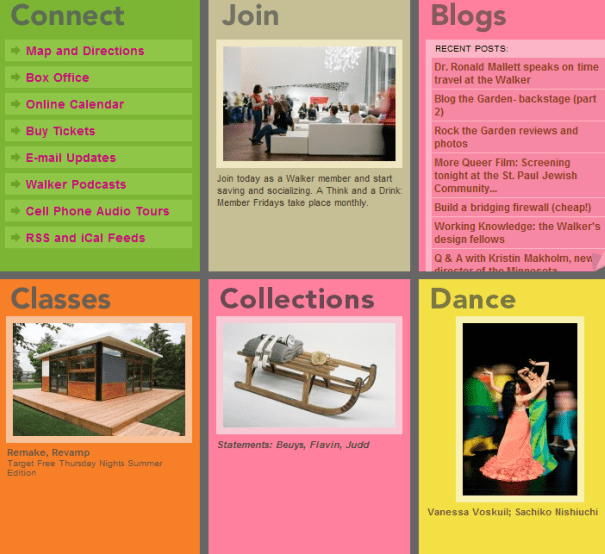
Other artists and museums are using social media thoughtfully and in big, bold ways (but not necessarily requiring big budgets). They’ve capitalized on the audiovisual nature of the Web to showcase the storytelling and community-building aspects of their work. For example, emerging art spaces can learn a great deal from Minneapolis’ Walker Art Center, where the exhibitions aren’t the only cultural experiences. Visitor options at WalkerArt.org include “Connect,” “Join,” and “Blogs” with content on design, education, new media initiatives, and visual and performing arts. They also publish art history and analysis podcasts on the museum’s iTunes U channel, and curators’ comments are available real time through the mobile system Art on Call.

walker
National Symphony Orchestra’s “Tweet Suite”
And in the performing arts realm, the “Tweet Suite” experiment is getting lots of buzz. The National Symphony Orchestra recently experimented with tweet tactics during Beethoven’s “Pastoral” Symphony at Wolf Trap. Though many were dubious, the orchestra tweeted notes of explanation from conductor Emil de Cou during the performance. (Example: “In my score Beethoven has printed Nightingale = flute Quail = oboe Cuckoo = clarinet — a mini concerto for woodwind/birds.”) Those interested sat in a designated area on the Wolf Trap lawn with their BlackBerries, iPhones, or other mobile devices. They followed @NSOatWolfTrap Trap to gain a new perspective on the score. And, you could also follow along without actually being at Wolf Trap at all. Though there has been a crescendo of moans in response from classical purists to the techno-intrusion into the traditional concert experience, innovation is important to integrate to insure a continuing appeal to audiences in a world full of so many voices and media competing for our time and attention.

What so you think of Tweet Integration and Meta Operation? Let me know.

The Tweet Life: Ambient Intimacy and other Epiphanies

twitter6To say Twitter is hot is quite an understatement. In a world thirsty for leadership, everyone seems to be following these days. In the past week, I have attended some interesting presentations on the Internet and making sense of social media for business. It’s a reality and a resource—no doubt, but there is still rampant confusion about how to optimize it. I am very interested to know how you view social media and use it.

I met a true social media master this week—Ben Smithee. He is an astute Gen Y entrepreneur steeped in the savvy of social media—particularly for market research. He says no one has ever called him a guru, but I certainly would. Ben has an impressive grasp of all the latest and greatest tools. Regarding Twitter, he recommends we not Tweet as a business, but as a human voice. Make your messages personal and conversational—not institutional or programmatic. Interact with customers, donors, or clients as individuals, not a solid mass. It’s Communication 101. Make it intimate. Vulnerability is where real connection happens. In fact, I absolutely loved Ben’s term for social media—“ambient intimacy.”

And then, it hit me! That’s the magic of social media. It permeates our everyday lives. Call it habit or even addiction, as some have. For many, social media can become part of their everyday unconscious impulses. That’s why we need to pay attention to this stuff. We can actually use Twitter and other social media tools to enhance intimacy with patrons, donors, customers, or clients by humanizing your missions and our value propositions. Focus on the anecdotal—on stories with authentic fiber, as opposed to carefully crafted messages. It takes so much more than an understanding of the tools and technology that power social networks to inspire change and build long-term, meaningful relationships. You must immerse yourself in the conversation.

You are the personality and the soul of the brand you represent. Think of social media as the page where we compose digital poetry to inspire. These tools are born from technological advances, but they are rooted in the most basic elements of human communication—conversation, curiosity, caring, and connection. I guess you could call them the four “Cs” of social media—a girl’s (or boy’s) “second” best friend, I suspect. Here are a few more tips and concepts for your Tweet Sheet:

Tweet. Message to your followers.
Retweet. Share status messages on Twitter. It’s a great way of building relationships.
@Replies. Direct a message that is available to all. Great way to lift others up.
#Hashtags. Create ways to search and group information/initiatives/activities.#MoRanch
Promote your blog or podcast. But try to do it conversationally. Ask people what they think or pose a rhetorical question. Don’t just SPAM the URL. Also, be careful about headlines or questions that are TOO provocative. I have learned this the hard way. Sometimes it’s best to leave your clever copywriter hat in the closet and just be REAL.
Follow a specific cause of entity. Consider finding the right people tweeting about that cause or entity, and build a blended dashboard tool such as Hootsuite.
Understand how people are really using Twitter. Monitor the @ replies, and see how they interact with others. Some folks use Twitter like a megaphone, and others use it like a walkie-talkie.
Make business connections. As always, listen first. Learn more about the person, follow their links, read their blogs, and get to know them. As I have said in the past on my blog, it’s a courtship. You date before you marry. In this space, you listen, respond, and participate—before you pitch or solicit!
Create a tweet strategy. Instead of tweeting “what are you doing?” try “What are you passionate about?” The answer to that could be very interesting and revealing.

And for nonprofit causes, hashtags have become an effective tool in building awareness and motivating action. They make it easy to search and identify a particular trend. Blame Drew’s Cancer http://blamedrewscancer.com/# (hashtag: #blamedrewscancer) is a great example. Drew Olanoff recently contracted Hodgkins Lymphoma, and launched his campaign. The tweets are pulled into http://www.blamedrewscancer.com with the goal that their sheer volume will trigger a large donation from a nonprofit organization. The site recently announced that Livestrong will be a partner.

So, get creative! And let us know—what’s working for you? Follow me.