It’s All INREACH: Marketing Revisited

Inreach_sand“How odd I can have all this inside me and to you it’s just words.”

― David Foster Wallace, The Pale King

I hear nonprofits use the word “outreach” frequently.  We are doing an “outreach.” This can refer to everything from mission-driven programming — to marketing to fundraising.  They may even have an “outreach” department.” And many have even made it a verb. “We are outreaching across the globe.” But this brings to mind a sort of broad, cast-the-net-style effort, as opposed to a more targeted, precise, systematic approach — focused on engagement, conversions and revenue generation.  It’s like using the term email “blast,” versus “campaign” or “appeal.”

Recently, when I was working with one of my “heart” projects, I had one of those light-bulb moments. I really think there might be a more useful way to think about marketing for nonprofits — specifically digital tactics. And, actually, I suspect this can be applied across the board to other enterprises.

Ending the Silence is an important and powerful new program designed to help begin the conversation with adolescents about mental health and diminish the stigma that is so often a barrier to treatment.   The National Alliance of Mental Illness of Dallas (NAMI Dallas) is launching this region’s program in high schools, community centers and churches with high-impact, resource-rich presentations on how to recognize the warning signs of suicide and potentially life-threatening conditions, such as bipolar disorder, depression, borderline personality disorder, obsessive compulsive disorder, schizophrenia, and others.

The dedicated volunteer team is passionate about creating a solid foundation for growth — and is recognizing the value of building a sophisticated digital lead-generation engine.  To underscore this importance, I proposed a mental flip.  “Let’s think about outreach as INREACH.”

In reality, when we use targeted marketing tools effectively, we are actually attracting suspects, prospects, and clients/donors based on their terms and interests.  We are simply opening the door— allowing the momentum of their needs to flow— satisfying their unquenched desires for life-changing experiences — inside. It’s just a different way of looking at the process.

Feeding the Beast

Consider SEO and SEM – the alchemy of Google — great examples of “inreach.” They are both cottage industries and sciences in their own right that intertwine.  Basically, Google is hungry beast; it’s favorite food is content — (and, of course, paid advertising.) But we as content producers want to create content Google craves — and that’s content that allows us to be FOUND when people search. SEO best practices (and white-hat tricks) help us do that.  Keywords give us the clues we need to tell us how our prospects are looking for us.  As digital marketers and humans, really, we would probably be better served if were more focused on “inreaching,” in general, as opposed to outreaching.   If we think more about how we can frame our missions in ways that satisfy the needs of our donors/partners/clients—instead of how that donor (or partner) will satisfy us, we will be much further down the success highway.

After all, when you think about it, we are all merely facilitators of desire . . .

What are you reaching for on the outside that has been inside — all along?

“If I ever go looking for my heart’s desire again, I won’t look any further than my own back yard. Because if it isn’t there, I never really lost it to begin with!”    — Dorothy

Taking the Last Mile to Heart

highway“The Last Mile” is a phrase used in the telecommunications and technology industries to describe the final piece of the communication journey that connects the network to the end-user or customer. In more jargon-y tech circles, it’s often referred to as the “last-mile problem,” because the end link to consumer is too often disproportionately expensive or difficult to achieve. Even compared to the costs associated with rolling out broadband wire and hardware across the globe, last-mile connections have been plagued with technological issues, infrastructure barriers, and high costs.

It’s so beguiling that there are many publicly traded companies focused exclusively on the “challenge” of facilitating this precarious one-on-one connection.  Pursuit of this delicate alignment extends to transportation logistics, as well. From traditional heavy goods shipments to  e-commerce-driven home deliveries, the last mile plays a critical role in the supply chain. It’s the ultimate destination – the final frontier.  Get it wrong, and you risk customer alienation.  Get it right, and you create a meaningful, high-value, and potentially lasting relationship.

That’s the connection. My wheels are turning—thinking about that ever-so-bumpy road that often characterizes “the last mile” in our most intimate relationships.  A metaphor is born. You know the adage that those closest to us have the power to hurt us the most deeply. Well, here we go.  I think the struggle of the last mile speaks to this.  Yet, the sad part is that some us never let anyone down that barren stretch of highway into the inner sanctum of our hearts.  Even if someone finds entrance ramp, there are often too many twists and turns, culverts and crevasses—too many dead-ends . . . or just too many barricades.  Plus, there are all those the emergency vehicles that come out of nowhere—crimson lights blazing and sirens shrieking! Or, the bridges may be washed out due to years of emotional storms and deferred maintenance. There are a myriad of reasons.  And this can be true in a variety of contexts—family, friends, romantic partners—even work. Your “last miles” can be very painful, even scary, but they are worth the trip.

Being more mindful and aware has definitely helped me enrich some of my “last mile” journeys recently — and I find that I am becoming more appreciative of noticing these attributes in my fellow travelers, as well.  I feel the “last mile” in any relationship is best navigated as a two-way street. After all, it’s where the rubber truly meets the road, right?

You fish or you cut bait, as they say.  Face it.  “Last-mile connections have been plagued with technological issues”— especially when some of us have more baggage on the bus than others.  So, to stay on track, unpack with care and compassion when necessary—and refuel when needed. Traveling light – and maximizing flow . . . here I go.

Believe Them.

angelou2When people show you who they are, believe them.”
~Maya Angelou

This is one of my favorite quotes from the remarkable Maya Angelou.  She expressed so many ideas and notions of the heart with such raw eloquence and clarity. As one who has struggled with clouded filters in my life, this resonates deeply.

Live in authenticity—not to satisfy the expectations of others, nor the perceived expectations of anyone else.  It also means resisting the impulse to change, cajole, alter—or otherwise attempt to “fix” another.  Peacefully release and allow . . .  others to walk their own divine paths.  Easier said than done, right? Instead, you may simply choose a different reality.  Fighting or feeling dismayed gives the recipient of that energy power.  Taking a different path alleviates so much stress and pain.

It is such an essential lesson for productivity, sanity and happiness. And at the core of this awareness is mindfulness.  Marsha Linehan, a noted American psychologist and author, created Dialectical Behavior Therapy (DBT) around this philosophy. It’s a powerful form of psychotherapy that actually combines behavioral science and brain theory with Buddhism  tenets—acceptance, meditation and mindfulness.

In the spirit of our dear Dr. Angelou, who touched so many, we can all seek this state of inner peace and mindfulness—to communicate in truth—internally and externally. To believe in the veracity of what is.  But we cannot if we are not clear— about who we are and how we feel.   This, indeed, is the journey.  In lieu of a mindfulness retreat or a series of therapy sessions with Dr. Linehan, here are a few ways to get a dose of this mindfulness practice:

  • Focus on one thing at a time

Try giving up multitasking occasionally. It exacerbates stress and states of confusion. Handle one thing and one thing only—mindfully in the moment.  Step away from the phone.

  • Do what works

You do not always have to be right— make a statement, issue and edict, or win the war. Don’t cut off your nose despite your face. Think twice before you send that blazing email copying the president.

  • Set achievable goals

Set aside the BHAGS for a while (the big, hairy, audacious goals – as a former boss used to call them).  Focus on the attainable ones. Give yourself some wins!

  • Nurture friends, connections, and support

Build a network. Connections are so important. They give you strength and a soft place to land when you run out of steam and your resources dwindle.  YOU don’t have to be everything to everyone.

  • Exercise

Keep moving. Reduce your physical vulnerability. You know about this one already.

  • Be grateful

Find something to be grateful for every day. It multiplies (even at work).

There are more, but this is a great place to start. Until we understand exactly who we are and how we process stimuli, many of our reactions will be wildcards. This takes work, because so much of our communication is conducted on autopilot—hardwired and subconscious. There are no easy answers, but if we are mindful of our issues, we can begin asking better questions . . . What do you think?

← Back

Thank you for your response. ✨

Letting Go.

Roses_3_1.0

“Faith consists in believing what reason cannot.”  

– Voltaire

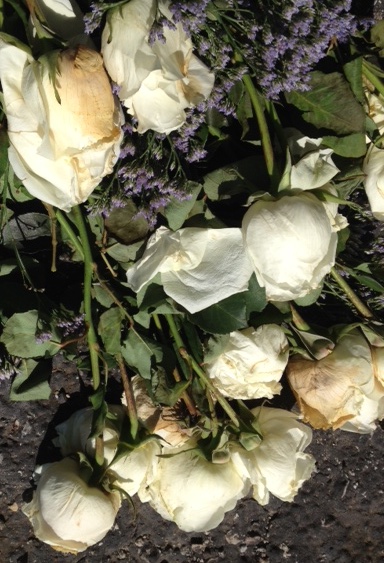
On Saturday, we honored the memory of Everett E. Gantz Jr. with a quiet, traditional Episcopal memorial service.  After nearly 89 years on this earth, my father was still an enigma to many— and to me in many ways. Few truly knew the man behind the stoic, Midwestern-chiseled facade— and the charismatic artist/wife of more than 50 years.  Thankfully, my dear sister Melissa gave a lovely, instructive “reflection” that filled gaps and hearts.

The loss is palpable—and beginning with my mother’s devastating stroke in January 2010, the grieving process has been a lingering one.

Plus, as a single, working mother of two growing boys, remembering to “put the oxygen mask on first” is a constant effort—and a daily focus of my mindfulness practice. However, I am certainly no role model for the “sandwich generation,” and I guarantee you that I still get tangled up in the roughage, as it were.  Still, I have come to understand that the frustrating stubbornness and vitriol I have encountered on “both sides of the bun” often mask the poignant vulnerabilities that quite frequently melt my heart.

Mastin Kipp, one of my favorite daily inspirational mentors, says, “When you let go and admit it, accept that you have moments of being a mess, and you share that feeling at times with the rest of us, then you can step into a larger, freer life.”

So, with another Mother’s Day behind us and a new normal dawning, I have revisited something I wrote several years ago for my mom:

Letting go.

No need to give to feel anymore.

Her bare spirit shines — less the veneer.
Without speech, without talk
Now real.

Transcending words.
The essence of her soul.
Awareness without comprehension,
Cognition, no.

She looks at me finally – and actually sees.

Letting go of need.
Content to be.
Helpless though.
Fights her wheeled prison.
Her body knows now
To bridge the chasm.

There between this Scylla and Charybdis.

And yet he still clings.
Together alone.
Denies to suppress — but never go home.

Letting go of control.
But the seizures defy
The years and the secrets
He insists to know why.

Anger. Passion. Pain.

A stone cold wall.
What a loss — so far.
Tear us apart and we fall.

Oh, to let love  . .  .

So, letting go.

–Elaine

← Back

Thank you for your response. ✨

Are You Content?

let goIt’s hard to believe I started writing this blog  five years ago. Seems like five months in many ways—and yet, so much has changed and at breakneck speed.  The trailblazers along the social-media super highway—accelerators such as Chris Brogan, Brian Solis, Beth Kanter and Clay Shirky—continue to inspire and challenge my thinking as they constantly reinvent, re-calibrate and re-conceptualize their own approaches to social media, their audiences, the web and their own livelihoods. It is, indeed, an ever-changing frontier out there . . .well, out here, as well.

Where are we five years later? Where am I? Good question.

I suspect I am inordinately philosophical as I review the past five years today. Such monumental milestones. Such enormous challenges. Such “opportunities for growth.” “What doesn’t kill you will make you stronger.” Kelly Clarkson? Well, I believe Friedrich Nietzsche said it first.

Having just returned from another day of waiting in the hospital to hear news about a gravely ill parent, I am considering the past five years even more pensively.  Just moments ago, I was straightening the few sparse gray hairs dancing across my emaciated father’s damp, ashen forehead as I watched him fight for every shallow breath.

The weight of the past few years as a single mom has been palpable —encompassing my mother’s death a year a half ago after complications from a massive stroke—as well as other daunting challenges.  Let’s just say, life has been messy. However, thank goodness, the learning has been rich and the clarity gleaming beyond the fog. Fortunately, I have been open to it. Not just about the social media stuff, mind you—but most everything, really— life, love, the way I tick, and  my relationship to all of it—media, circumstances, feelings, places, people . . . That’s the good part.

“I am convinced that life is 10% what happens to me

and 90% how I react to it.” 

― Charles R. Swindoll

This awareness is informing my writing, as well. Hence, I have arrived at this very blog post. In fact, I now think our relationship to our content is probably more important than the content itself.  In this new media, mega-sphere world, we have admittedly become obsessed with our gadgets—with the act of communicating. As Sherry Turkle says in Alone Together, we are too busy communicating to really connect.

Ironically, we began this social journey with rabid focus on the technology—the latest whiz-bang toy du jour. What will we do with Twitter? Instagram? Yada? Yada? Then, we moved to “content marketing.” We’re all about the content. The what. Serve it up in giant scoops of frothy, delicious digital goodness—early and often to satisfy Google’s ravenous, insatiable appetites. Businesses and thought leaders have been maniacal about producing “the right content” with the right words at the right time. SEO-yea!  Maximizing, masticating and matriculating . . .

But, now, I think it’s really and truly about relating.  Getting to the heart of the matter, right?  Who are we? What are we about?  Not another refill of the cloying Kool-Aid. After all, what does really matter?

Am I conscious? Am I present?  Am I paying attention? No more facade, thank you.

What does this mean to our marketing plans? Not sure. And more important, what does this mean to our relationships—whether they are with friends, romantic partners, business partners, parents, children, subordinates, siblings, superiors, colleagues, employees, customers, shareholders, vendors, service technicians, teachers, neighbors, customers, students, etc.  . . . or the person behind us in line at Target? Anyone.  You? It means being fully present, in the present—in the relationship.  (And I don’t mean with your phone, but that’s another post.) In fact, the truth is there will come time when . . .

The words don’t matter, because we cannot hear them.

The affectations, witty banter and posh color choices don’t matter, because we cannot see them.

And what matters is simply spirit—being there.

Life coach Martha Beck says, “Little miracles begin happening to you whenever you turn toward your right life – even if it’s in the middle of the muck and mire. Small miracles turn into big ones.” We just need to pay attention.

So, once again, I ask the question, are you content?