Letting Go.

Elaine Gantz Wright is a speaker, writer, and social media strategist. Contact her at elgantz()yahoo.com.

I have departed from the norm on this post—drafting a tribute to my ailing mom and dad.  Functioning as a single, working mom in the “sandwich generation” is challenging and often exhausting–with aging parents clinging to this earth on one side and iconoclastic teens defiantly creating their brave new world on the other. The stubbornness and isolation in both contrast the poignant fragility that often dissolves my heart. So, this is for you:

Letting go.

No more need to give to feel.

Her bare spirit shines — less the veneer.
Without speech, without talk.
Now real.

Transcending words.
The essence of her soul.
Awareness without comprehension.
Cognition, no.

She looks at me finally – and actually sees.

Letting go of need to know.
Content to be.
Helpless though.
Fights her wheeled prison.
Her body unknown.

Sings without words.
Feels without touch.

And yet he still clings.
Desperate – together but alone.
Denies to suppress.
Still nerves don’t lie.

No control and seizures defy.
Those pills that made him lame.
What they resisted they claim.

Anger. Passion. Pain.
A stone cold wall.
What a loss — so far.
Tear us apart and we fall.

Oh, to let love . .  .

So, letting go.

The Social Network: Living Out Loud

Elaine Gantz Wright is a speaker, writer, and social media strategist, helping neighborhood businesses expand word-mouth-marketing exponentially–driving referrals, repeat business,  and revenue.

I saw The Social Network this weekend.  The film was entertaining, but I think it lacked the depth and  gravitas I expected— especially given the enormous impact of Facebook, the social media phenomenon that  has quite literally changed the world.

Facebook is the decade’s  Zeitgeist— a global cultural phenomenon, affecting how people share information,  communicate, build relationships, promote  businesses, live their lives, and even think.  In fact, Facebook has become so intertwined with our psyches and daily habits that many people report checking their Facebook pages before brushing their teeth or drinking their first cups of coffee. It’s a social, cultural, and behavioral force – even more than a technological one.  As NYU new media professor Clay Shirky says, “Tools don’t get socially interesting until they get technologically boring.”

In the past six years, the world has learned to live out loud.

But still, I feel the producers of The Social Network did not truly comprehend the intellectual significance of their subject matter—the social media revolution, itself.  It’s more than the story of a business success and damaged relationships.  It seems the anachronistic storytelling medium of film was not equipped to peel the social media onion with much precision.  It captured the almost cliché concepts of narcissism and greed as they relate to success. What the film neglected was a deeper exploration a whole new way of interacting and being.

I think the essential irony of the film — social misfit Zuckerberg’s inventing a whole new way of socializing was far more compelling than a seemingly endless stream depositions and legal puffery. I would love to have seen his parents and understood more about his family dynamic and his childhood relationships.

I think his story is actually just scratching the surface.  There will be so much more to Mark’s tale–past and present.   The opening and closing scenes actually captured some of Zuckerberg’s pathos, but the rest of the film seemed pretty one-dimensional—simply documenting events and allegations.

At his very core, Mark wanted to be part of something, to belong – to be loved.

And isn’t that what we all want? Facebook fills a universal human need in an increasingly impersonal world.  It’s so fascinating that Mark Zuckerberg’s  naiveté and painful awkwardness gave birth to a communication revolution.

I would even venture to say we could take that twist even further. As I studied the characterization in the film, I could not help by think of  Asperger’s Syndrome, the autism-spectrum condition which causes difficulty processing information and relating to people. His  off-the-charts intellect, arrogance, laser focus on Facebook, and his debilitating social insecurity seemed textbook.   I have read that Albert Einstein and even Bill Gates have exhibited Asberger’s indicators. This just gives more credence to BubbleLife Media CEO Jeff Farris’ theory, “Nerds rule the world.” As Mark said of his creation, “We don’t know what it will be.”  Those words apply to Facebook , his personal journey, and the burgeoning social media landscape.

What did you think of the film? Of Zuckerberg? Social media?

I hope you dance

Elaine Gantz Wright is a speaker, writer and social media strategist, helping neighborhood businesses expand word-mouth-marketing exponentially–driving referrals, repeats and revenue.

OK, you may have seen this, but I just had to post. Besides speaking to the career vicissitudes of the social media professional, I think it exemplifies the confusion and churn surrounding implementation of the social media “function” in enterprises — large and small these days. It’s a very interesting place to be — in the middle of a swirling vortex. But isn’t the eye of the storm supposed to be the calm place? Hmmmm. Film at 11:00. (or on YouTube, as the case may be).  Reminds me of one of my favorite quotes:

// Enjoy.

How are you managing social media in your business?

The Price of Friendship?

Elaine Gantz Wright writes about optimizing social media, life, and spirit. Reach her at elgantz()yahoo.com

Each friend represents a world in us, a world possibly not born until they arrive.” ~Anäis Nin

Place on the Pyramid

When you Google “Facebook friend value,” the results are as myriad as searching for Obama. From .37, to $1, to more than $100. But really, what is the price of friendship, it’s true value— and what about it’s cost?

Clearly, we are still grappling with defining the intrinsic value of social media—trying to make a tangible assessment, a dry measurement, but it still eludes us. It’s “like trying to put spilled Jell-O back into a bowl with your bare hands,” as my dear friend Joe Teague used to say. The range of responses to the Facebook question embodies this challenge somehow, but I believe this conversation still misses the mark.

I loved what media guru (social and otherwise) Erik Qualman sought to qualify rather than quantify the role of social media in his live presentation to the Dallas Social Media Club last week. (#smcdallas) This is an interesting foil to his previous messaging. You’ve probably seen his seminal, statistics-sprinkled videos about social media. In socio-psychological terms, he posits that social media falls very near the base of Maslow’s famed “Hierarchy of Needs”—just above safety and security. According to Qualman, social media behavior fulfills our basic need for a sense of belonging and connection. Isn’t that priceless?

Still, his stats are staggering—here’s my top-ten list from the latest video:

1. Over 50% of the world’s population is under 30.
2. 96% of them have joined a social network.
3. Facebook now tops Google for weekly traffic in the U.S.
4. Facebook added over 200 million users in less than a year.
5. iPhone applications hit 1 billion in 9 months.
6. We don’t have a choice on whether we DO social media, the question is “How well we DO it.”
7. The fastest growing segment on Facebook is 55-65 year-old females
8. Generation Y and Z consider e-mail passé – some universities have stopped distributing e-mail accounts—
instead they are distributing: eReaders and iPads.
9. Social Media isn’t a fad, it’s a fundamental shift in the way we communicate
10. The ROI of social media is that your business will still exist in 5 years

So, one particular exploration of Facebook friend value caught my attention recently. Research firm Synapse has determined what the average Facebook friend/fan is worth — $136.38. They calculated this amount when they questioned 4,000 fans of 20 of the top brands on Facebook — including Nokia, BlackBerry, Victoria’s Secret, Adidas, Nike, Coca-Cola, Starbucks and McDonald’s — asking why they were fans of those companies or brands and about their past and future purchasing behavior. Other key findings include:

• On average, fans spend an extra $71.84 they would not otherwise spend on products they describe themselves as fans of,
compared to those who are not fans.
• Fans are 28 percent more likely than non-fans to continue using a specific brand.
• Fans are 41 percent more likely than non-fans to recommend a product they are a fan of to their friends.

You might be saying, “Hey, those companies are all retail, consumer-facing. What about B2B?” And you would be very astute. That’s true. It’s a little easier to connect revenue to engagement around sales of cell phones, underwear, tennis shoes, and food. But, the formula holds for other scenarios. My own experience with the REO Expo is a case in point. We managed to reach and even surpass our attendance goal of 1,500 earlier this month through a strategic, integrated cultivation of our target business audience, using Facebook, LinkedIn, Twitter, focused professional communities, and email marketing promotions.

To paraphrase Erik Qualman, change is the only thing that’s certain about today’s social media landscape. So, refresh, regroup, and eat your Wheaties.

In the meantime, how would you calculate the value of a friend?

Making It

“Our most important decisions are discovered, not made.”
– Anne Wilson Schaef

Not too long ago I saw duct-tape marketing guru John Jantsch speak at the Social Media Club of Dallas. I really do admire these entrepreneurial guys in the social media marketing space who have managed to morph their marketing savvy and strategy into an actual, lucrative businesses. Chris Brogan wrote something recently in his blog about a tangible tool called “booth tag” by Bill Finn —sort of a social media commodity that impressed him as a proof-of-concept for trade show interaction.

“Marketers are service providers. They make
things that stop the moment they stop (normally).
Yes, they make ads or whatever, but those
are in service of other people.”

Brogan is right on target here. Monetizing services is tough. It’s really only sustainable if the service in question enjoys a very high perceived value, and the gigs keep coming. Attorneys and doctors have managed to ratchet up the hourly rates historically, but even they are feeling the pinch of the limping economy. I have come to believe that so much of business and even success, in general—is directly related to “discovering”—a precise brand of enlightenment that allows one to see when and how to leverage an idea, product, relationship, or service into a broader application. It’s a canny awareness that positions you at the right place and right time with the right preparation. It may even be unconscious. Theologian Frederick Buechner talks about this on a much deeper and spiritual level. “Listen to your life,” he counsels. “See it for the fathomless mystery that it is. For in the end, all moments are key moments, and life itself is grace.”

We all tend to go through our moments, our days, or months, and our years—and sometimes, even our lives on auto-pilot—numb to who we are and disengaged from our own realities. We become so caught up in “doing” that we often stop “being.” Only when something major, even cataclysmic, occurs that rattles us to the very core do we start to examine our raw, vulnerable, exposed souls in the harsh light of the storm’s aftermath or in the ongoing tumultuous sea of stress and upheaval. Then, we may ask, “Who am I?” “What am I here to learn?” “How is this series of events informing my journey?” More important, “What the heck should I do now?” “How can I make the money I need to support my family and still care for critically ill parents?” These are all understandable questions, but it’s frightening to feel so uneasy in your own skin at such a seasoned age—when you are supposed to have it all figured out. What’s that schmaltzy song about clowns—“Isn’t it queer? Losing my timing this late in my career. . .”

Socrates said, “Beware the bareness of a busy life.” How timeless is that? How apropos for 2010. And how easy it is for feelings extreme loneliness to engulf us in the waves of hubbub and chaos—even with so many well-meaning people around. There always seems to be so much to juggle, so darn much that demands our attention—especially as a single mother of two teenage boys (one college-bound, I hope); a herder of a dog and two cats; a niece of an 86-year old infirm aunt, who is all alone; an ex-wife, still engaged in an awkward tango—and the daughter of two recently incapacitated parents. The sandwich generation, a double-decker, and I’d definitely say I’m in a bit of a real pickle.

Back to the paying attention part . . . Just where do we start? How should we be? How have you handled the most difficult transitions and challenges in your personal or business life—as individuals, as family members, and as communities? How did you get through? How can we support each other in these difficult times when the path seems so unclear and the outcomes so murky? Share your thoughts.

Elaine Gantz Wright writes about social media and self-discovery. Contact her at elgantz()yahoo.com.

Finding Community Where We Live

I heard Peter Lovenheim, journalist and author of In The Neighborhood: The Search for Community on an American Street, One Sleepover at a Time, on NPR this morning. His commentary resonated with me as I considered the meaning of community—online and otherwise. Lovenheim felt compelled to write the book after a tragic murder-suicide on his Rochester, NY street, because he suspected less anonymity among his neighbors might have saved the woman’s life.

Lovenheim wonders how people can live side-by-side and know literally nothing about each other, so he brazening invites himself to “sleep over” at the houses of his neighbors. Startling stories unfold. Throughout, he waxes nostalgic about idyllic days of neighborhood barbecues, sipping lemonade on the front porch, and sharing coffee around the kitchen table. This reminded me of that classic 1960 Twilight Zone episode, “Next Stop Willoughby,” in which the addled, frantic advertising exec dreams of a simple, stress-free, small-town life in the late 1880s. (I won’t spoil the twist if you haven’t seen it.)

In his neighborhood, Lovenheim mourns the loss of a slower pace which allowed the time for casual, incidental, face-to-face contact. “We just don’t have the old-fashioned conversations with our neighbors,” laments Lovenheim. One postman he interviewed remarked, “More than 90% of the time, customers would rather give misdirected mail back to me than walking it over to the person next door.” Could our desire for privacy and independence be trumping our basic need for human interaction?

As Lovenheim reaches out to those living in closest proximity, he finds others also secretly searching for connection and yearning for an era gone by. He asks the question—do neighborhoods really matter, and is something missing in our lives when we live among strangers? What makes a group of houses or apartments a neighborhood? Just as our IP addresses have no real meaning in terms of our identity online, our street addresses have become less important components of our personal definitions of “community.” Of course, there are exceptions, but no matter where you are, building front-yard community takes a deliberate effort.

Our lives are fuller and more hectic than ever—with dawn-to-dark work schedules, overly programmed children, mind-numbing commutes, single-parent households, and vehicles available to whisk us off to soccer games, book stores, and gyms across town. Could this lack of physical, local connection be part the dramatic revolution driving social media behavior? After all, isn’t it where we live?

We have to pass laws now to keep people from texting on their mobile phones while they drive. Facebook has become a verb, and I’m in touch with friends I never see in person through their 3:00 and 4:00 am Twitter/Facebook posts. Personal stories. Tales of insomnia. Crumbling relationships. Critically ill relatives. Job losses. Despair. Joy. Finding pig for Farmville. It runs the gamut. And when we do converse real-time, it most likely includes a conversation about the latest iPhone app. Our communication behaviors are no longer sequential—talk on phone, go next door to borrow an egg, then sit down to watch the evening news. Communication is integrated and intertwined. It’s more like a tapestry. I text my son and check email on my mobile phone—while standing in line at the grocery store. No wonder we all fried by the end of the day.

Longing for human interaction, we have moved to online neighborhoods for the same casually intimate, psycho-social interactions that earlier generations experienced in the driveway or on the front lawn. Today, the difference is we access them on our own time. Many say the Internet is detrimental to human relationships, but it’s really a double-edged sword. I contend the Web is really creating a new context and a revised process. In fact, there are a growing number of sites designed specifically to facilitate interaction within neighborhoods, apartment complexes, and subdivisions. Examples include ineighbors.org and aroundme.net. Even Neighborhood America, a large white-label online community company, has recently rebranded as Ingage Networks.

However, social media just may be coming full-circle—trending back toward geo-location. Maybe you really can go home again—virtually speaking, of course. Whether we’re tracking nearby Tweets, stamping your Passport on Gowalla, or unlocking a Swarm badge on Foursquare, we are reorienting our interaction geographically – focusing to people and places around us. The operative question on all this geo-updating is—does anybody really care? But isn’t that what they said about Facebook and Twitter?

Hmm, could a virtual lemonade stand be next? What do you think?

ElaineGantzWright’s blog is for people interested in using the Web and online marketing to make a difference. Elaine covers social media for business, education, and nonproifts. Contact her — elgantz @yahoo.com

Facebook Valentine

Dear Reader, my sincere apologies for such a lengthy gap between posts. I so appreciate your attention to my musings, and I have missed you sorely. Contact me at elgantz @ yahoo.com if I can help you with social media, marketing, or communications.

On Friday, January 8, 2010 I received a Valentine’s Day card from my Mother. She has always been quite enamored with all things mail—postal, that is, so I am never surprised when her cards arrive in multiples and even early, but this was significantly early, even for her. I remember a palpable queasiness in the pit of my stomach, but then, I had felt vaguely uncomfortable about my stubbornly aging parents for weeks. Then, late in the afternoon on Friday, January 29, I received a call at work that my Mother was in the ICU at Parkland. She had been rushed there after a devastating stroke.

I think my heart broke that day.

This was the beginning of an agonizing journey, including my father’s concurrent debilitating health emergency and affliction in February. I will refrain from the intricate detail, but I can tell you that pondering and writing about the theoretical vicissitudes of social media and well—just about anything—became somewhat daunting when dealing with all-consuming family health crises, especially when they came in duplicate, simultaneously—and when the relationships involved had been historically complicated in the best of times. I have been forced to recalculate, reconfigure, re-evaluate, and re-prioritize—everything. And pray most of the time.

Then, consider all of this in the context of an abrupt job “separation.” It’s just one more wave in what a friend has called my “Life Tsunami.”

OK, Universe, you have my attention! Now what?

Still, as a single mother of teenage boys, I have become quite adept at riding the “survival roller coaster” for the last ten years. Yet even Monsieur Maslow, guru of all things needy, would posit that I have many blessings to count amongst the mayhem—and you better believe I am grasping for every possible nugget of gratitude as I navigate the debris sprinkled across these choppy seas.

Fundamentally, I am enormously grateful for reconnection with my sister, Melissa, as we pilot the blind turns, brick walls, and back alleys of the frustrating health care labyrinth. My boys have shown considerable compassion and maturity inside the ominous hallways of ICUs and rehabs—and my friends and church family have provided me with exceptional support. But, one of my most surprising and cherished blessings has been social media—specifically, Facebook. I’m not talking about ROI or conversions or leads. I’m talking about the kind of value for which there is no metric, no Google analytic.

In those darkest moments of loneliness and fear, reading the sincere, heartfelt messages of my friends, near and far, recent and from years ago, on Facebook has been a true gift from God. The arrival timing of some of these messages has been nothing short of Divine.

This sounds somehow saccharin—even to me, but this precious prose has served a miraculous refuge of comfort and warmth for me—when nothing else in my rattled world has seemed steady or solid. The magic even came in the form of timely medical advice from Ann, a Northwestern pal I had not spoken with for years, who had actually worked with stroke rehabilitation patients. Amazing! So, in honor of those special souls in my life . . . here’s my true inspiration. I share a sampling of some of my favorite Valentines—even though it’s March:

From Stephen:
The point is that we do not know why these things happen, and it seems like at ‘our age’ things should be easier. I am sure I am not the only one who knows and is encouraged by the fact that you will come through things wonderful, wiser, stronger, and maybe happier. Thoughts and prayers are with you.”

From Kim:
“Everyone of us is called upon, probably many times to start a new life. A frightening diagnosis, a marriage, a move, loss of a job; and onward full tilt we go, pitched and wrecked and absurdly resolute— driven in spite of everything to make good on a new shore. To be hopeful, to embrace one possibility after another— that is surely the basic instinct—crying out, ‘High Tide! Time to move out into the glorious debris. Time to take this life for what it is.’ ” — Barbara Kingsolver

From Joe:
Prayers ascending, Elaine. May God’s abiding presence bring you strength, courage, wisdom, and peace to face this onslaught of challenge.

From Laura:
You are a gift to me, and I love you very much!

From Carol:
“Holding you and your family in The Light.”

And from Amy . . . just hours before everything changed professionally:
“We can’t take all our fortitude and will and force the outcomes we want. But we can open our hearts and time to letting God be right in the middle of everything for us. Daddy and I just said goodbye to his Mom. We didn’t find God in the worrying about what to do for Granny next; we found God in the small stuff, like brushing her hair, and in supporting each others’ choices and process of holding on while letting go. Whatever you face, I trust you will face it with the openness and authenticity I see in your eyes when I look at your pictures. And you will never face it alone.

With deepest gratitude! Share your mystical experiences . . .I would love to hear . . .

Connecting in Isolation

Montreat, North Carolina

I just returned from four days in a miraculous place— Montreat, North Carolina. The peaceful, picturesque village sits nestled in a perfectly pristine pocket that exemplifies some of God’s finest handiwork. Though the temperature hovered near the single digits, the still, stately Black mountains seemed to envelope the eleven of us like a lush, tonal blanket—sprinkled with glistening stars of ice in the day and shimmering droplets of light in the deep, velvet night.

The event featured many fascinating people, presentations, and workshops—intertwined with personal introspection and self-discovery. It is what many have deemed a “thin place”—a location on earth where the veil separating the spiritual realm and the material world is slightly more diaphanous—perhaps, even permeable at times.

This is a place where hearts hunger and souls search.
It is a place where the emotional epiphanies are as significant at the intellectual insights—where relationships with acquaintances deepen and the murkiness of life’s choices becomes profoundly clear.

But this serene setting was only part of the magic. The Rev Brian Blount, President of Union Theological Seminary and Presbyterian School of Christian Education, a commanding, compassionate presence, proclaimed during the first night’s session, “You are those God has called” to help nurture and guide our youth. And much like Dorothy, who travels to the exotic Emerald City in search of what is missing in her life, I found the most potent wisdom right there among the very people who accompanied me to this remarkable destination. Silly and seasoned; sassy and sweet; sardonic and soothing—these special spirits shared rich truths and many a poignant moment.

I was humbled and honored to be in this eclectic First Presbyterian Church entourage.

Erika Funk, Youth Initiative Minister of Broad Street Church in Philadelphia, spoke about the lack of empathy she sees in so many of our youth. Is the pseudo interaction of texting and IMing developing a false sense of intimacy—impairing our ability to measure, assess, and manage interpersonal communication effectively? Fundamentally, are we losing the ability to truly “be” with people? It’s a disturbing notion. She is concerned that our young people may be stepping back and away from those in need. “I see a fear of the homeless,” she says. She suspects this may be the consequence of this under-developed empathy and increasing personal isolation. It’s as if our powers of observation and understanding are evaporating.

“There are just fewer and fewer instructions for being human,” Funk laments.

That resonated with me. The paradox is chilling. Is our humanity really waning as we mindlessly create more and more ways to connect? ‘Tis a question worth pondering—in many realms of life—especially since turning back the hands of time is not really a viable option. If this “erzatz engagement” is the new reality, perhaps it is time to revise our expectations of interaction. Or, is it? What does it mean to the way we approach and frame our communication—now and in the future?

What are your thoughts? What do you think about the behavior changes media drives?

Peas in a Pod

ElaineGantzWright’s blog is for people interested in using the Web and online marketing to drive social change. Elaine covers social media for nonprofits, philanthropy trends, online giving, cause marketing, random life musings, and more.

Peer Factor

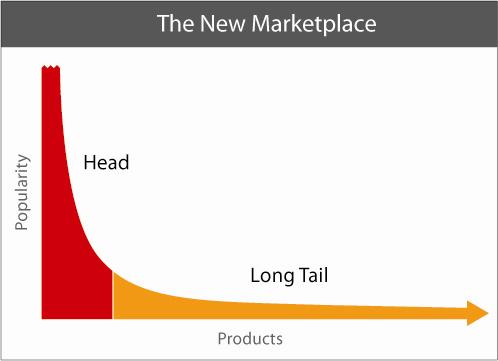
In his epoch-defining book, The Long Tail, WIRED editor-in-chief Chris Anderson explores the statistically rooted theory of the same name. He suggests, “Our culture and economy are increasingly shifting away from a focus on relatively small number of hits (mainstream products and markets) at the head of the demand curve, and moving toward a high number of niches in the tail.” He romances this theory in the context of dominant market forces, including the diminishing physical requirements of distribution and the proliferation of individual content producers empowered by the Internet and new media technologies. His clarifying point is critical,“The Long Tail starts with a million niches, but it isn’t meaningful until those niches are populated with people who want them.” Ay, there’s the rub.

The Democratization of Production and Distribution.

Everything really comes down to the basic economic concept of demand and supply. The difference now is that the cost of reaching niches is reducing dramatically -– thus driving the democratization of production and distribution. In his addendum chapter, Anderson addresses the “the Long Tail of marketing.” The premise of this chapter is that the fragmentation of markets is requiring the fragmentation of marketing. More important, as I have proposed in earlier posts, the user-driven Web is turning the paradigm of traditional marketing communication on its ear.

“(With) individuals trusted more—institutions trusted less—the most effective messaging comes from peers. Nothing beats word of mouth, and as we’ve seen, the Web is the greatest word-of-mouth amplifier the world has ever seen.”

Understanding the Dynamic of Influence.

The integration of the multimedia Web and mobile technologies has forged a brave, new frontier. The medium is really no longer about the message. It’s about the relationship. Therefore, businesses and institutions must shift focus away from managing the message and move toward relating with the influencers. This means leveraging personal affiliations, relationships, and their voices. It also means listening and monitoring through resources, such as:

TechnoratI
Google Trends
Social Networks

The hyperlink is, indeed, the new response device. Traditional metrics, such as audience size and readership are becoming increasingly stale and even irrelevant. Now, response is measured in real-time interactivity—clicks and click-thrus. Action. Anderson says “The hyperlink is the ultimate act of generosity online.” Placing a hyperlink in content signifies tacit endorsement of the associated content and simultaneously gives the author a new brand of authority—the power to refer.

The Power of the Peer.

Given this new focus on the influencer, we as fundraisers could not be in a better place. The development “sweet spot” has arrived. We know that that people give to people, not institutions. And now, the cultural evolution of communication is giving our volunteer fundraisers more power and influence than ever before.

We just need to find the right tools to make them the most successful “askers”— and us the most effective “impresarios” of generosity. Let us know what you think. Ask a question, or leave a comment. Tell us know what you are doing to lake advantage of this rare moment in history.

Elaine Gantz Wright writes about social media that matters. Find her at elgantz@ yahoo.com

Literary Device


I admit it. I like texting. I don’t know if it is the writer in me, the social media maven, mom, or bon vivant, but I am hooked. It took me a while to embrace it, but I have found the direct access to those I care about quite appealing. I can receive a quick text at work when my son gets home from school—or a little casual banter with a flirtatious friend—without the formality a phone conversation entails. I guess it’s part of the “instant,” byte-sized culture we are creating.

So, I suspect that’s why I haven’t stopped thinking about Stanford University professor Andrea Lunsford’s five-year examination of college students’ writing in the Stanford Study of Writing. From 2001 to 2006, she collected 14,672 student writing samples—everything from in-class assignments, formal essays, and journal entries to emails, blog posts, and chat sessions. What she discovered might surprise you. The reality is that the most popular technological tools and social media platforms continue to receive plenty of sanctimonious slander—from Facebook’s narcissistic drivel, to PowerPoint’s bullet-point prose, to Twitter’s unintelligible prattle. But in true train-wreck fashion, we just can’t seem to stop looking.

As many traditional academicians, such as University College of London English professor John Sutherland have moaned, social media and texting are “dehydrating language into bleak, bald, sad shorthand.” However, the new media guard thinks differently. The truth is that communication is evolving and morphing as breakneck speed, and we are right smack in the middle of maelstrom. Granted, it’s hard to achieve the perspective needed to make sense of it all. Professor Lunsford suggests:

“I think we’re in the midst of a literacy revolution the likes of which we haven’t seen since Greek civilization. Technology isn’t killing our ability to write. It’s reviving it—and pushing our literacy in bold new directions.”

The first thing she found is that young people today write far more than any generation before them. That’s because so much socializing happens online, and it almost always involves text. Moreover, they are writing more than any previous generation, ever—in history. They are immersed in a complex, often confounding, new space where writers and their audiences are now enmeshed. “The consumer has become the producer,” says Professor Clay Shirky. The rules of the game have changed, and communication mores have been literallyturned upside down.

Lunsford pins her findings to the pervasive psycho-sociological trends defining our culture. She says, “More than earlier generations, young people today are aware of the precarious nature of our lives. They understand the dangers that await us. Hence, writing is a way to get a sense of power.” Interestingly, comparing the Stanford students’ writing with their peers from the mid-1980s, Lunsford found that the writing of today’s students is about three times as long today—they have “the ability to generate more prose.” I guess expressing ideas about hard things requires hard words. And when grappling with hard things, “I don’t think it can be worked out in 140 characters,” Lunsford contends. How ironic.

Of all the writing that the Stanford students did, a stunning 38 percent of it took place out of the classroom. Lunsford calls this “life writing.” Those Twitter updates and lists of 25 things about yourself add up. The fact that students today almost always write for an audience—a real switch from the prior generation—gives them a different sense of focus and message impact. It’s almost as if we are narrating our own lives. In interviews, students defined good prose as something that had an effect on the world. For them, writing is about persuading, organizing, and debating. It’s about finding a voice and taking a stand—even if it’s a review of the latest movie.

The Stanford students were almost always less enthusiastic about their in-class writing, because it had no audience but the professor. It didn’t serve any purpose other than to get them a grade. How about texting those LOLs and emoticons? Are they eroding the sanctity of academic writing? When Lunsford examined the work of first-year students, she didn’t find a single example of texting speak in an academic paper.

At the end of the day, texting has it’s time and place. And, there’s the rub. It represents a fascinating dichotomy of communication. It is simultaneously immediate and intimate, yet passive. It finds you any time of the day or night (no matter where you are—except driving, I hope) in the soft, fleshy palm of your hand. But at the same time, it gives you the power to choose when and how you want to respond. To engage or not to engage—the new “text-i-quette.”

Some psychologists warn against this intimate anonymity—that it encourages risky behavior. Elisabeth Wilkins wrote in a blog post that “texting can rob our kids of the ability to interact socially”—diminishing the importance of body language and facial expressions. I think the evolution of email and texting has radically changed the way we communicate and how we express ourselves, but I’m not sure it’s something we can condemn or alter. It simply is. It is the new communications behavior and landscape, which is inextricably intertwined with the technological innovation that enables it.

What do you think of texting and the changing patterns of communication? How are they affecting us as human beings?

Elaine Gantz Wright writes about social media that makes a difference. Contact her at elgantz @ yahoo.com